




Narita Airport Final-Stop Guide: Lockers, Loose Change, Duty-Free Pickup, and More
- Written by: LIVE JAPAN Editor
Your exciting Tokyo trip is coming to an end, and as you arrive at Narita Airport, a few “sweet problems” might be on your mind. Maybe your suitcase is overflowing with souvenirs, you have leftover coins you are not sure how to spend, or you still need to pick up tax-free items purchased in the city. No worries. This guide answers all the practical questions you may face at Narita Airport, from luggage storage and mailing services to handling loose change and collecting duty-free purchases. With these tips, you can breeze through your final travel tasks and wrap up your journey on the perfect note.
Main image: PIXTA
This article contains promotional content
- Table of Contents
-
- Q1. Bought Too Many Souvenirs? Can You Mail Items Home from Narita Airport?
- Q2. Still Have a Bunch of Coins? Here’s How to Use Them
- Q3. Want to Drop Off Your Luggage at the Airport Before Sightseeing? Are There Places to Store Suitcases?
- Q4. If I chose airport pickup for my tax-free purchases, where do I collect them?
- Q5. Which terminal do airlines use at Narita Airport?
- Q6. How do I handle tax-free procedures?

Q1. Bought Too Many Souvenirs? Can You Mail Items Home from Narita Airport?
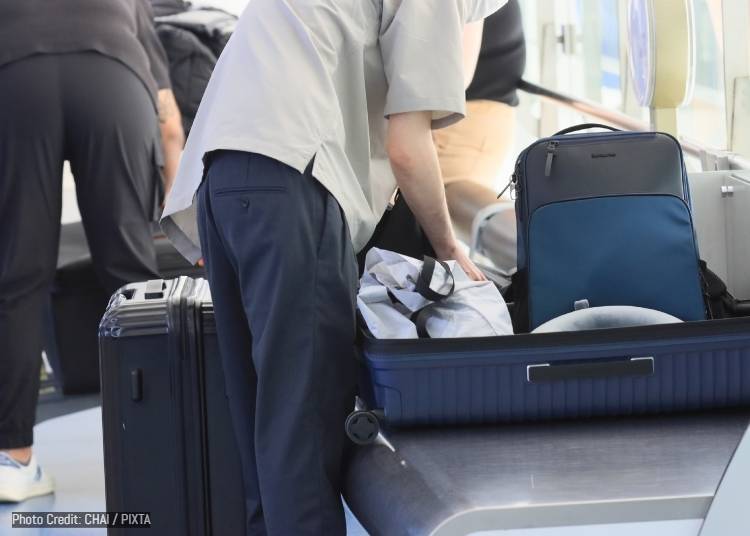
Yes. Narita Airport has post offices in Terminal 1 and Terminal 2. Terminal 3 does not have a post office, so travelers departing from Terminal 3 will need to use the post office in Terminal 2 if they wish to send items home.
When mailing a package overseas, items must be properly boxed. For parcels up to 30 kilograms, the maximum box size is length 1.5 m + (height + width) × 2 = 3 m. Boxes can also be purchased at the post office, with the largest size being 345 mm × 445 mm × 340 mm. Postage varies by weight and shipping method. Airmail usually takes 3 to 6 days, while surface mail may take 1 to 2 months.
All three terminals have mailboxes in the departure lobby. Stamps are available at post offices or convenience stores in the airport. Note that there are no mailboxes after security, so be sure to mail anything before passing through the checkpoint.
Terminal 1
・Postal counter: Central Building, 4th floor
・Hours: 8:30 AM to 8 PM
Located near the central escalators, surrounded by shops and restaurants. You can send parcels, letters, or buy commemorative stamps here.
Terminal 2
・Postal counter: Departures, 3rd floor, north side near Counter B
・Hours: 8:30 AM to 8 PM
Convenient and easy to access for Terminal 2 travelers.
Terminal 3
・Postal counter: Not available. Please use Terminal 2.
・Mailbox: Near the 2nd floor food court
・Stamps: Available at the Lawson convenience store inside the terminal
How to Send an International Package: Simple Steps
Even if you do not speak Japanese, there is no need to worry. Japan Post encourages using the online digital form for international shipping, which is faster and more accurate than filling it out by hand.
1. Best method (online form):
Fill out your shipping details in advance on the Japan Post International Mail website. The system will generate a QR code.
2. At the airport:
When you arrive at the Narita Airport post office, scan the QR code at the dedicated machine (ゆうプリタッチ). It will print your shipping label automatically, and no handwriting is required.
3. Information you must prepare:
If you cannot fill out the form online, be sure to have the following details ready (English is recommended):
・Recipient: Name, address, phone number
・Sender: Your hotel name or address in Japan
・Contents: Simple English descriptions such as “Souvenirs” or “Clothes”
4. Declare value and pay:
Choose the shipping method (EMS, airmail, or surface mail), declare the package value, and select tracking if needed. Hand your package to the counter staff for weighing and payment.
Q2. Still Have a Bunch of Coins? Here’s How to Use Them
If you have spare coins, you can always spend them on small snacks at convenience stores. Narita Airport also has plenty of capsule toy machines, which are perfect for using up the last 200 to 500 yen in your pocket.
If you still have a large amount of coins, look for a Pocket Change machine. These machines convert your Japanese coins and bills into digital money or points, such as e-wallet credit or Amazon gift cards. It is one of the easiest and most modern ways to deal with leftover currency.
Pocket Change Locations
・Terminal 1 (T1): Central Building, 1st floor (before security); Central Building, 4th floor (before security)
・Terminal 2 (T2): Main Building, 1st floor (Arrivals / before security)
・Terminal 3 (T3): 2nd floor (before security)
Narita Airport Gachapon (Capsule Toy) Zones
Narita Airport has a huge number of capsule toy machines across all terminals, making it easy to spend leftover coins. Terminals 1 and 2 have the largest collections, with more than 100 machines each.
・Terminal 1 (T1): Mainly located on the 5th floor. The gachapon area is in the Central Building on the 5th floor, near restaurants and shops, and is very easy to spot.
・Terminal 2 (T2): Mainly located on the B1 floor. The gachapon area is in the Main Building B1, near the train station entrance and convenience stores. You will see it as you walk from the trains toward the departure lobby.
・Terminal 3 (T3): Fewer machines, mostly located near the dining area on the 2nd floor.
If you still have coins left after that, the simplest solution is to use the airport’s retail services. Convenience stores such as Lawson, FamilyMart, and 7-Eleven accept coins, making them perfect for picking up last-minute snacks and drinks. Vending machines throughout the airport are also a great way to use up remaining loose change.
▼ See More Articles About Narita Airport ▼
Q3. Want to Drop Off Your Luggage at the Airport Before Sightseeing? Are There Places to Store Suitcases?
Many travelers spend their final day by heading to the airport first, then visiting nearby attractions such as Naritasan Shinshoji Temple or Shisui Premium Outlets. But carrying a suitcase around can be tiring and inconvenient. Fortunately, Narita Airport has coin lockers as well as staffed luggage storage counters. Leaving your bags at the airport lets you explore the area freely without dragging heavy luggage along.
1. Coin Lockers
The coin lockers at Narita Airport have been fully upgraded to touchscreen models and accept IC cards such as Suica, making them very convenient to use.
Pricing System and Rates
Narita Airport lockers use two different fee systems: daily rates and hourly rates. Prices and usage rules vary by size and terminal.
・Daily rate (mainly in T1 and T2):
Charges are calculated per day. Usage from the time you start until midnight counts as one day. After midnight, the next day’s fee is added.
Small items: 400 yen per day
Standard large lockers (fit a typical suitcase, approx. 86 cm tall): 800 yen per day
・Hourly rate (mainly in T2 and T3):
Charges are calculated by the hour.
Small items: 300 yen for the first 6 hours
Large items: 600 yen for the first 6 hours
After 6 hours, the additional fee per 24 hours matches the daily rate.
Extra-large lockers (for long items such as skis, approx. 227 cm tall): 1,200 yen per 12 hours
・Maximum usage period:
Up to 8 consecutive days (5 days for extra-large lockers).
Important Notes
If you need to store more than one item, coin lockers are usually the most cost-effective option. However, Terminal 3 does not have a staffed luggage storage counter, so if you find an available locker in T3, it is best to use it right away.
2. Staffed Luggage Storage Counters
If all the coin lockers are full, you can store your bags at a staffed luggage storage counter. Pricing depends on the size of your luggage (small, medium, large), and fees vary slightly by operator, so be sure to confirm directly at the counter. Since these services charge per item, it is usually more economical to consolidate your belongings into as few pieces as possible.
Look for counters operated by JAL ABC, which handle most temporary storage services at Narita Airport. You can find them at:
・Terminal 1 (T1): North Wing and South Wing on the 1st floor (Arrivals), and on the 4th floor (Departures)
・Terminal 2 (T2): 1st floor (Arrivals) and 3rd floor (Departures)
Please note that Terminal 3 (T3) does not offer staffed luggage storage services.
▼ View More Articles About JAL ABC ▼
Q4. If I chose airport pickup for my tax-free purchases, where do I collect them?
If you purchased large or bulky tax-free items in the city, carrying them around can be inconvenient. Many BicCamera stores offer a convenient airport pickup service, allowing you to collect your items at the airport on the day of your departure. To pick up your goods, simply go to the JAL ABC counter located in the departures area of each terminal (the same counter mentioned in Q3 for luggage storage). You must present the original purchase receipt when collecting your items, so be sure not to lose it.
・Pickup location: JAL ABC counters in the departures area of each terminal
・Required documents: Your purchase receipt (or pickup slip)
In addition to city shops like BicCamera that offer delivery to the airport, you can also enjoy a “downtown duty-free” shopping experience in Ginza. Two examples are Japan Duty Free GINZA and Lotte Duty-Free Ginza. When you shop at a downtown duty-free store, your tax-free items are delivered directly to an airport pickup counter. The advantage is that your purchases do not count toward your baggage allowance.
To collect your items, prepare your passport, boarding pass, and the export confirmation document (pickup voucher). After completing outbound procedures at Narita Airport or Haneda Airport, visit the designated Duty-Free Pickup Counter (市中免税店引渡しカウンター) to retrieve your goods.
▼ Read More About the Narita Airport Area ▼
Q5. Which terminal do airlines use at Narita Airport?
Airline terminal assignments at Narita Airport may change from time to time, so it is always best to confirm before your flight. Based on the most recent information, here is where major carriers currently operate:
Terminal 1 (T1)
・Aero Mongolia (M0 / MNG)
・Aeromexico (AM / AMX)
・Air Busan (BX / ABL)
・Air Canada (AC / ACA)
・Air China (CA / CCA)
・Air France (AF / AFR)
・Air Japan (NQ / AJX)
・Air Seoul (RS / ASV)
・ANA (NH / ANA)
・Asiana Airlines (OZ / AAR)
・Austrian Airlines (OS / AUA)
・EVA Air (BR)
Terminal 2 (T2)
・Air Macau (NX / AMU)
・Air Premia (YP / APZ)
・Air Tahiti Nui (TN / THT)
・Air India (AI / AIC)
・Alaska Airlines (AS / ASA)
・American Airlines (AA / AAL)
・China Airlines (CI)
・Scoot (TR)
・Starlux Airlines (JX)
・Japan Airlines (JL)
・Cathay Pacific (CX)
・Hong Kong Airlines (HX)
・HK Express (UO)
・Greater Bay Airlines (HB)
・Tigerair Taiwan (IT)
Terminal 3 (T3)
・AERO K Airlines (RF / EOK)
・Jetstar Japan (GK)
About Terminal Assignments
Each airline determines which terminal it uses, and assignments may be adjusted due to schedule changes, operational needs, or seasonal demand. Because of this, it is important to recheck your flight information the day before departure to ensure you head to the correct terminal.
About Terminal 3 (LCC Terminal)
Terminal 3 primarily serves low-cost carriers (LCCs) and is the most remote terminal at Narita Airport. It does not offer services such as a post office or staffed luggage storage counters. After arriving at the nearest rail station (T2), passengers must walk a longer distance or take the shuttle bus to reach T3. If your flight departs from Terminal 3, be sure to allow extra travel time and complete any necessary counter services at T2 beforehand.
▼ Read More About Narita Airport Access ▼
▼ You May Be Interested in Booking ▼
Q6. How do I handle tax-free procedures?
Until October 31, 2026: In-store instant tax exemption
Most tax-free shops currently deduct the consumption tax at the time of purchase, meaning you pay the tax-free price immediately. However, under Japanese law, you must still have the purchase record attached to your passport (either electronic or paper) scanned at the customs declaration counter when you leave Japan. This completes the legal process for tax-free shopping.
Starting November 2026: Major changes to the tax refund system
Japan plans to revise its tax-free system for international visitors beginning November 1, 2026. Under the proposed system, travelers may need to pay the full tax-included price at the store and receive the tax refund at the airport when departing Japan. This would significantly change both the shopping and departure procedures. If you are traveling after November 2026, be sure to check the latest updates from the Japan Tourism Agency or the airport to avoid any issues with your refund.
▼ Read More About Tax-Free Shopping ▼
If you still have balance remaining on your Suica, Pasmo, or other IC transit cards, be sure to visit a JR or subway service counter before leaving Japan to process a refund. You can receive back both the deposit and any unused balance. It is a simple step that helps you wrap up your Tokyo trip on a perfect, worry-free note!
-
-
Address
Narita Airport, Narita-shi, Chiba, 282-0004
View Map -
Nearest Station
Narita Airport Station (JR Narita Line / Keisei Main Line / Narita SKY ACCESS Line)
-
Address
Narita Airport, Narita-shi, Chiba, 282-0004

*Prices and options mentioned are subject to change.
*Unless stated otherwise, all prices include tax.
Popular Tours & Activitiess

Recommended places for you
-
Ad

Vegetarian Dining in Saga: 8 Recommended Restaurants for Pizza, Pasta, and So Much More
-
Legends Return to the Skies! ANA Launches Three “Pokémon Jets” in 2026
by: Guest Contributor
-
Ad
Embrace Japanese Aesthetics and Tradition with the CITIZEN SAKURA Limited Edition and Other Popular Models
-
Ad

Savor Japanese Sake Culture: A Stroll Along Saijo Sake Brewery Street in Higashihiroshima City, Hiroshima Prefecture
-
Ad

Looking for a Top-Tier Japanese Tattoo in Tokyo? KAGEROU in Asakusa Makes It Easy
-
Japan’s Luxury Rail Journey: Explore Hiroshima, Miyajima & Iwakuni on the "Hanaakari"
by: Guest Contributor
-
Japan Relaxes its Multiple-Entry Visa Requirements for Filipinos: What you need to know
-
Tokyo Tsukiji|Tsukiji Area Map & Sightseeing Information
-
Ultimate Tokyo Transit Guide: JR, Subways, and Private Railways Explained, Plus Suica/PASMO and Money-Saving Passes
-

Tokyo Roppongi: 5 Most Amazing Spots at Roppongi Hills and How to Make the Best of Them!
-
Narita Airport to Ueno: Skyliner, Keisei Line, or N'EX? Compare Travel Times, Transfers & Fares
-
4 Easiest Ways From Narita Airport to Shinjuku: Best Transport Options Compared
- #best ramen tokyo
- #what to buy in ameyoko
- #what to bring to japan
- #new years in tokyo
- #best izakaya shinjuku
- #things to do tokyo
- #japanese nail trends
- #what to do in odaiba
- #onsen tattoo friendly tokyo
- #daiso
- #best sushi ginza
- #japanese convenience store snacks
- #best yakiniku shibuya
- #japanese fashion culture
- #best japanese soft drinks