



Skip Kyoto's Crowded Buses: 7 Train & Subway Lines That Make Sightseeing Easier (+Tickets)
- Written by: LIVE JAPAN Editor
Kyoto’s buses can get extremely crowded, especially around popular sightseeing areas. Fortunately, many of the city’s top attractions are also easy to reach by train or subway.
This guide introduces seven useful train and metro lines for sightseeing in Kyoto, including which attractions they serve, how to transfer between them, and where you can buy tickets or passes in advance. If you want to spend less time standing in traffic and more time exploring, these routes can make getting around Kyoto much easier.
(Main image: PIXTA)
(This article contains sponsored content)
- Table of Contents
-
- Why You Should Quit Relying on Buses in Kyoto in 2026
- Quick Comparison Guide: Which Train Should You Take for Each Destination?
- Kyoto City Subway: The Backbone of Getting Around Kyoto
- JR West: Fastest Speeds, Widest Coverage
- How to Use Kyoto’s Five Major Private Railways, Choose by Destination
- Keihan Electric Railway: The Line Connecting Kyoto and Osaka
- Kintetsu Railway: The Kintetsu Nara Line Linking Kyoto and Nara
- Heading to Kifune or Kurama? Take the Eizan Railway
- Kyoto’s Only Streetcar: Keifuku Electric Railroad (Arashiyama Line and Kitano Line)
- Kyoto Tango Railway: The Only Way to Reach “Kyoto by the Sea”
- Caution: Look-Alike Station Names That Can Trip You Up
- Ticket Strategy: IC Cards or Day Passes, Which Should You Choose?
- Travel Smarter and Rediscover Kyoto’s Elegance
Why You Should Quit Relying on Buses in Kyoto in 2026
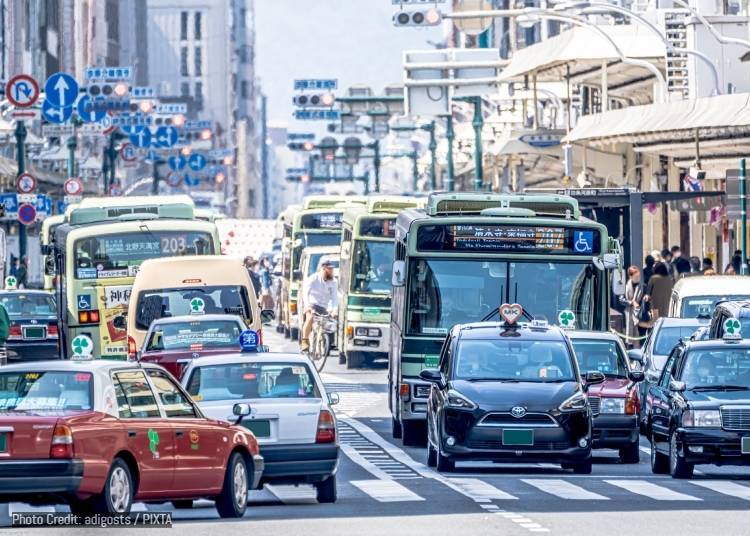
If your image of getting around Kyoto is still based on the idea that a single 500-yen bus pass lets you go everywhere, it is time for a serious update in 2026.
In the past, Kyoto City buses were a budget-friendly favorite for visitors. However, with the surge in tourism, overtourism has pushed the bus system to its limits. At the bus terminal in front of Kyoto Station, it is now common to see lines wrapping around multiple times. Add Kyoto’s narrow city streets and frequent traffic jams, and buses often move at a crawl. Even short distances that look easy on a map can end up taking twice as long by bus.
More importantly, the Kyoto city government has introduced strict new rules to ease congestion. Large luggage is no longer allowed on Kyoto City buses. If you are traveling with a suitcase larger than 20 inches and try to board a bus to your hotel, the driver has the right to refuse entry.
That is why the new rule for visiting Kyoto in 2026 is simple: take the train whenever possible, and only switch to other transport when rail lines cannot get you there. By making smart use of Kyoto’s seven major rail systems, which are unaffected by road traffic, and combining them with short walks or quick taxi rides, you can explore the city in a smoother, more efficient, and far more pleasant way.
Quick Comparison Guide: Which Train Should You Take for Each Destination?

Kyoto’s rail network is run by multiple companies, and many lines are not directly connected. This is often the most confusing part for first-time visitors. The good news is that you do not need to memorize every route map. You just need to match your destination with the best transport option.
Below are recommended first-choice routes for major sights, all designed to help you avoid bus traffic.
Arashiyama
・Best choice: JR Sagano Line. It is the fastest option from Kyoto Station at about 16 minutes and is not affected by road congestion.
・Alternatives: Hankyu Railway or Randen. Stay near Shijo Kawaramachi and Hankyu is convenient. Want a nostalgic streetcar experience? Choose Randen.
・Warning: Do not take the bus to Arashiyama. During peak seasons, buses can be stuck in traffic for a very long time.
Fushimi Inari Taisha
Best choice: JR Nara Line or Keihan Railway. Both JR Inari Station and Keihan Fushimi-Inari Station are right by the shrine entrance, making access extremely easy.
Kiyomizudera Temple
・Best choice: Keihan Railway plus a short taxi ride or walk. Get off at Kiyomizu-Gojo Station, then take a taxi for around 1,000 yen up the hill, or walk uphill for about 20 minutes.
・Warning: Taking Bus No. 206 directly from Kyoto Station is widely considered the worst option, with extremely long lines.
Kinkakuji Temple
Best choice: Subway plus a short bus or taxi ride. This is one of the few major sights not directly accessible by rail. Take the subway to Kitaoji Station, then transfer to a short bus ride or taxi to avoid congested central roads.
Kifune Shrine / Kurama
Best choice: Eizan Railway. This is the only rail line serving the area and is famous for its scenic routes, including the maple tunnel in autumn.
Nara Park
Best choice: Kintetsu Railway. Kintetsu Nara Station is much closer to Todaiji Temple and the deer area than the JR station, saving a significant amount of walking time.
Kyoto City Subway: The Backbone of Getting Around Kyoto
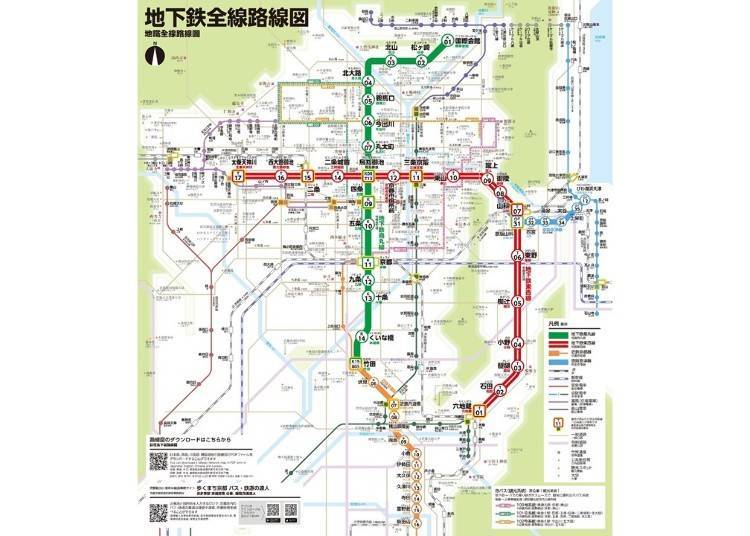
Kyoto City Subway has a very simple network made up of just two lines that form a cross shape. This makes it the core transport system for getting around central Kyoto. Its biggest advantages are punctuality, frequent service, and the fact that it is completely unaffected by road traffic.
- Karasuma Line
- ・Line color: Green
・Route direction: North to south, running through the heart of Kyoto
・Major stations: Kyoto Station, Shijo for transfers to Hankyu Railway, Karasuma Oike for transfers to the Tozai Line, Kitaoji for buses or taxis to Kinkakuji
・Role: The main artery connecting Kyoto Station with the city’s central shopping and business districts
- Tozai Line
- ・Line color: Vermilion
・Route direction: East to west
・Major stations: Nijojo-mae for direct access to Nijo Castle, Karasuma Oike, Sanjo Keihan for transfers to Keihan Railway, Yamashina
・Role: A key route for visiting Nijo Castle or transferring toward areas such as Lake Biwa and Uji
JR West: Fastest Speeds, Widest Coverage
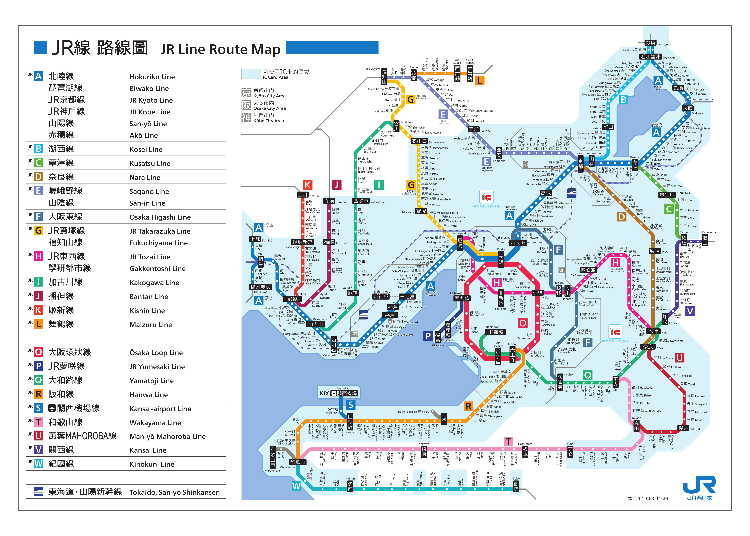
JR operates Japan’s largest rail network. Within Kyoto city, its role is best described as a fast way to reach outer areas and nearby cities. If you have a JR Pass for the Kansai area, rides on the lines below are included.
- Sagano Line
- ・Route: Kyoto Station to Saga-Arashiyama Station
・Why take it: This is the fastest way to reach Arashiyama, taking just about 16 minutes one way. By comparison, buses can take 50 minutes or more.
- Nara Line
- ・Route: Kyoto Station to Inari Station to Uji Station to Nara Station
・Why take it: This line links three major sights in one go: Fushimi Inari Taisha, Uji as the home of matcha, and Nara. Note that Inari Station is directly across from the shrine’s main gate, so access could not be easier.
- Kyoto Line
- ・Route: Kyoto Station to Shin-Osaka Station to Osaka Station
・Why take it: For travel between Kyoto and Osaka, the Special Rapid Service takes around 30 minutes, making it one of the most efficient options for both sightseeing and commuting.
How to Use Kyoto’s Five Major Private Railways, Choose by Destination
Kyoto’s private railway network is extensive and extremely useful for sightseeing. With the exception of Kintetsu Railway, most private lines do not pass through Kyoto Station. Instead, they connect directly to major shopping districts and popular sightseeing areas.
In many cases, using a private railway is more convenient than taking JR lines or the subway, especially when your destination lies outside the city’s central transport hubs.
Hankyu Railway: The Only Private Railway Linking Kyoto, Osaka, and Kobe

Hankyu Railway is the only privately owned railway that directly connects Kawaramachi in Kyoto, Umeda in Osaka, and Kobe-Sannomiya in Kobe. Because it links these three major urban centers so seamlessly, Hankyu plays a key role in travel across the Kansai region, especially for sightseeing and shopping.
Hankyu operates an extensive network made up of nine lines, including the Kyoto Line, Takarazuka Line, Kobe Line, Arashiyama Line, Senri Line, Minoo Line, Itami Line, and Imazu Line. Among these, the Kyoto Line and Kobe Line are particularly popular with visitors, as they serve many of the region’s most convenient and lively areas.
For travelers heading from Kawaramachi in Kyoto to Umeda in Osaka, the Kyoto Line limited express is the best option, covering the route in about 45 minutes. If your destination is Kobe-Sannomiya, you can transfer at Juso Station from the Kyoto Line limited express to the Kobe Line limited express. The full journey takes roughly 1 hour and 20 minutes, making cross-city travel smooth and efficient.
Travel tip: If you plan to move frequently between Kyoto, Osaka, and Kobe, the Hankyu Tourist Pass is worth considering. It offers unlimited rides on Hankyu lines for a set period, allowing you to explore major sights across the region without worrying about individual fares.
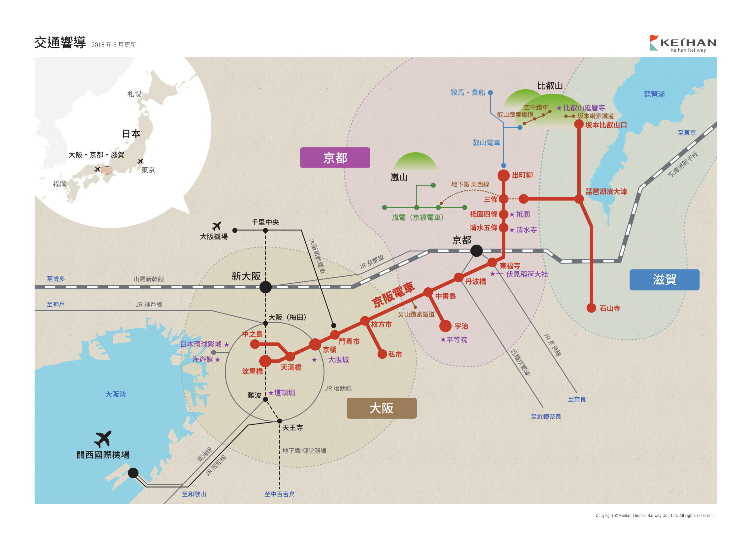
Keihan Electric Railway: The Line Connecting Kyoto and Osaka
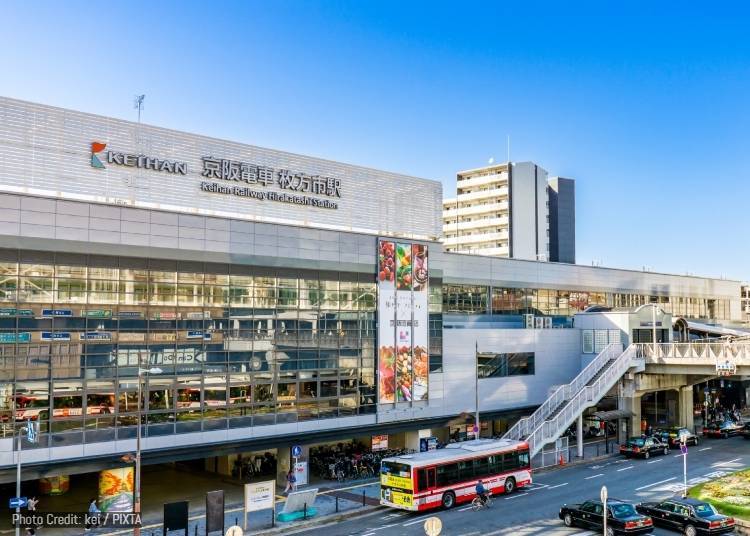
Keihan Electric Railway connects Kyoto and Osaka, with its name derived from “Kei” for Kyoto and “Han” for Osaka. The network includes several lines such as the Keihan Main Line, Uji Line, Katano Line, and Keishin Line, but the routes most useful for sightseeing are the Keihan Main Line and the Uji Line.
The Keihan Main Line is especially convenient for traveling between Kyoto and Osaka, while the Uji Line makes it easy to visit Byodoin Temple in Uji. On the Kyoto side, the main terminus is Demachiyanagi Station. On the Osaka side, trains run to Yodoyabashi Station and Nakanoshima Station. Taking a limited express train between Demachiyanagi in Kyoto and Yodoyabashi in Osaka takes about 55 minutes, making Keihan a practical and reliable option for intercity travel.
Kintetsu Railway: The Kintetsu Nara Line Linking Kyoto and Nara
Kintetsu Railway operates the longest private railway network in Japan, spanning Osaka, Kyoto, Nara, Mie, and Aichi. For sightseeing, the two most useful routes are the Kintetsu Kyoto Line, which connects Kyoto Station with Yamato-Saidaiji Station in Nara City, and the Kintetsu Nara Line, which runs from Osaka-Namba Station to Kintetsu-Nara Station.
The Kintetsu Kyoto Line is especially convenient for travelers heading from Kyoto to Nara, with several notable sights along the way. Highlights include Fushimi-Momoyama Castle near Kintetsu-Tambabashi Station, as well as Amida-ji and Gokuraku-ji temples near Tonomosho Station. With stations located closer to major attractions than many JR stops, Kintetsu lines are often the most efficient choice for exploring Nara and its surrounding areas.

▼ Explore More Articles About Nara ▼
Heading to Kifune or Kurama? Take the Eizan Railway
Best for: Travelers visiting Kifune Shrine, Kurama-dera, or Mount Hiei.
Key highlight: A must-ride during the autumn foliage season. The train passes through a famous maple tunnel, where tracks are surrounded by brilliant red and orange leaves, creating one of Kyoto’s most scenic rail journeys.
Transfer tip: The starting station for Eizan Railway is Demachiyanagi Station. You will need to take the Keihan Railway to Demachiyanagi first, then transfer to the Eizan Main Line or Kurama Line to reach your destination.
Kyoto’s Only Streetcar: Keifuku Electric Railroad (Arashiyama Line and Kitano Line)
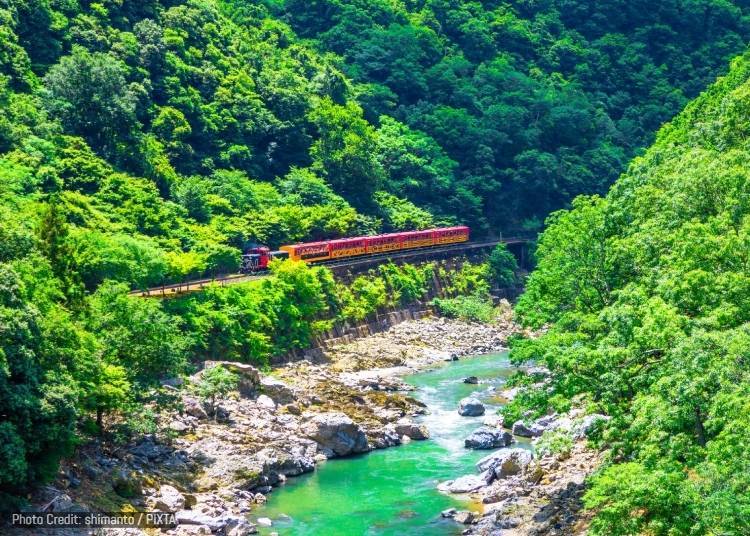
Randen is Kyoto’s only remaining streetcar system, officially operated by Keifuku Electric Railroad. It is a great option for travelers who want a nostalgic experience, or those moving between the Kinkakuji and Ryoanji area and Arashiyama.
Running with compact one- or two-car trains directly along city streets, Randen offers a slower, old-fashioned ride that feels very different from subways or JR trains. It is one of the most charming ways to see everyday Kyoto pass by at ground level.
At Arashiyama Station, you will also find a well-known foot bath on the platform, where you can soak your feet while waiting for the next train, a small but memorable Kyoto-style touch.
Most visitors use the Arashiyama Line to reach Arashiyama itself, but there is a lesser-known route that truly shines during cherry blossom season. By transferring at Uzumasa-Koryuji Station to the Kitano Line, you can explore some excellent seasonal sights.
The Kitano Line runs from Uzumasa-Koryuji to Kitano-Hakubaicho. Highlights include the cherry blossom tunnel between Narutaki and Utano, where the tram passes through trees in full bloom in spring. The line also provides easy access to Kitano Tenmangu Shrine, famous for plum blossoms and prayers for academic success, as well as Ryoanji Temple, known worldwide for its Zen rock garden.

Keifuku Electric Railroad Route Map (Arashiyama Line and Kitano Line)
Kyoto Tango Railway: The Only Way to Reach “Kyoto by the Sea”
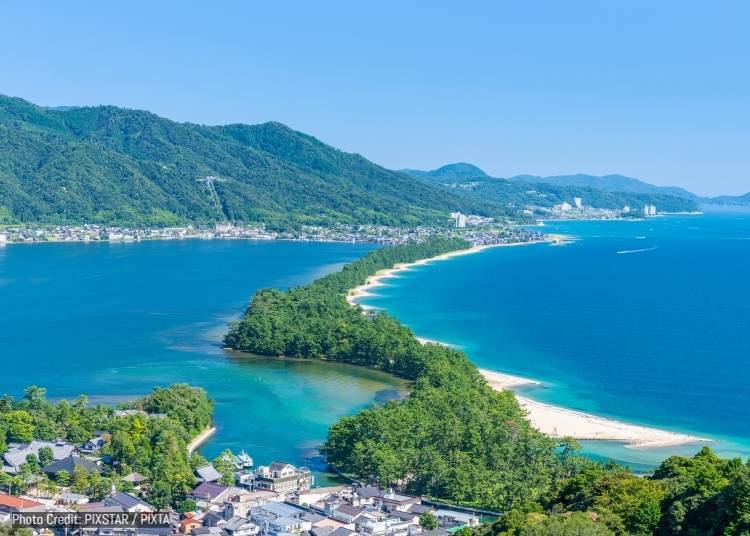
If you are planning to visit Amanohashidate, one of Japan’s Three Scenic Views, or the famous boat houses of Ine, this railway is essential. Located in northern Kyoto Prefecture, Kyoto Tango Railway operates three exceptionally scenic lines.
The Miyafuku Line connects Fukuchiyama and Miyazu. This is the key route used by limited express trains such as the Hashidate service from Kyoto Station to Amanohashidate.
The Miyatoyo Line runs between Miyazu and Toyooka. When heading to Amanohashidate, this is the line you will ride after reaching Miyazu.
The Miyamai Line links Nishi-Maizuru and Miyazu. It follows the coastline of Wakasa Bay and offers especially dramatic sea views. This is also where the popular sightseeing trains, the Kuro-Matsu and Aka-Matsu, operate.
Key tip: If you hold a JR Kansai Wide Area Pass, you can ride the Kyoto Tango Railway at no additional cost. This makes it one of the best-value ways to explore Kyoto’s northern coast and enjoy some of the region’s most beautiful scenery.

Caution: Look-Alike Station Names That Can Trip You Up
Many station names in Kyoto sound similar, but their actual locations can be far apart. To avoid meeting at the wrong place or wasting time walking in the wrong direction, watch out for these three common traps.
Trap 1: “Kyoto Station” Is Not Universal
・Reality: Hankyu Railway does not have a station called Kyoto Station.
・What happens: Many first-time visitors buy a Hankyu day pass and plan to head to Kyoto Station to catch the Shinkansen, only to realize the train does not go there. Hankyu’s main terminal in Kyoto is Kyoto-Kawaramachi. To get from Hankyu to Kyoto Station, get off at Karasuma Station and transfer to the Karasuma Subway Line.
Trap 2: The Three “Arashiyama Stations”
・Reality: There are three different Arashiyama stations in Kyoto, operated by JR, Hankyu, and Randen, and they are all in different locations.
1. JR Saga-Arashiyama Station: Closest to the scenic train and the bamboo grove.
2. Randen Arashiyama Station: Located in the heart of the shopping area and closest to Tenryuji Temple.
3. Hankyu Arashiyama Station: On the opposite side of the river. You need to cross Togetsukyo Bridge to reach the main sightseeing area.
・Tip: When meeting someone, always specify which railway company’s Arashiyama Station you mean.
Trap 3: “Gojo” or “Kiyomizu-Gojo”?
・Reality: Gojo Station on the subway and Kiyomizu-Gojo Station on the Keihan Line are about a 15-minute walk apart.
・What happens: If you are heading to Kiyomizudera, take the Keihan Line to Kiyomizu-Gojo. If you get off at Gojo Station on the subway, you can still walk there, but it will take significantly longer.
Ticket Strategy: IC Cards or Day Passes, Which Should You Choose?
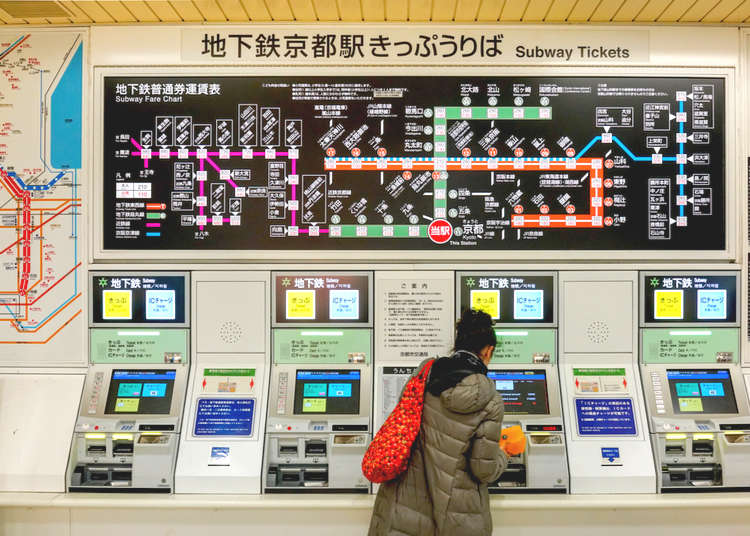
In 2026, with the simple “bus-only day pass” now a thing of the past, choosing tickets in Kyoto has actually become much easier.
Recommended: Subway and Bus 1-Day Pass
・Price: 1,100 yen for adults. Price subject to official updates.
・Coverage: All Kyoto City Subway lines, Kyoto City Bus, Kyoto Bus, and selected Keihan Bus routes.
・Best time to buy: This pass is a great deal if your accommodation is not close to a subway station, or if you expect to transfer between subway and bus more than three times in one day. It lets you use the subway to bypass traffic-heavy areas, then switch to buses for last-mile access to sights.
Most flexible option: IC card (ICOCA or Suica)
・Strategy: One card, total freedom.
・Why it works: Kyoto has too many different railway companies to easily break even on a single operator’s pass unless you ride the same line repeatedly in one day. With an IC card, you simply tap and ride whatever comes first, whether it is a private railway, JR train, subway, or bus. It is the most stress-free and flexible way to get around. Do not lock yourself into one route just to save a few hundred yen.
Travel Smarter and Rediscover Kyoto’s Elegance
Kyoto’s beauty lies in its relaxed pace, but not in moving slowly because you are stuck on a crowded bus.
Under the new travel reality in Kyoto in 2026, learning to break the habit of relying on buses makes a real difference. By combining the speed of JR lines, the reliability of the subway, and the convenience of private railways, you can experience a version of Kyoto that feels calmer, smoother, and far more refined.
On your next visit to places like Kiyomizudera or Arashiyama, use this guide to choose the smartest transport options. Avoid the crowds, move with intention, and enjoy the timeless atmosphere of Japan’s former capital the way it was meant to be experienced.
▼ Explore More Articles About Kyoto ▼

The LIVE JAPAN editorial team is a multinational group made up of native editors who have lived in Japan for over five years and Japanese editors who love to travel. Together, we share the best of Japan, offering cultural insights, historical context, event updates, and travel-friendly deals, to support your journey every step of the way.
*Prices and options mentioned are subject to change.
*Unless stated otherwise, all prices include tax.

Popular Tours & Activities
Recommended places for you
-
Sunflower terminal (Osaka) Terminal 1
Other Sightseeing
USJ, Nanko Port
-
Yodobashi Camera Multimedia Umeda Store
Shopping Malls
Umeda, Osaka Station, Kitashinchi
-
Myoshin-ji Temple
Temples
Arashiyama, Uzumasa
-
ISHIDAYA Hanare
Yakiniku
Kobe, Sannomiya, Kitano
-
Goods
Yoshida Gennojo-Roho Kyoto Buddhist Altars
Gift Shops
Nijo Castle, Kyoto Imperial Palace
-

Jukuseiniku-to Namamottsuarera Nikubaru Italian Nikutaria Sannomiya
Izakaya
Kobe, Sannomiya, Kitano
-
Top 3 Bus Tours to Arashiyama & Kinkaku-ji (Amanohashidate Included)
by: Hyungil Kim
-
This October, Japan's Bullet Train Is Launching an Ultra-Luxurious New 'Supreme Class' Shinkansen
by: Wemmy Chau
-
Top-Booked in Japan: Must-Try Sushi in Osaka for First-Time Visitors
by: Guest Contributor
-
5 Gorgeous Limited-Edition Goshuin Coming to Kobe’s Ikuta Shrine This September 2026
by: Wemmy Chau
-
Missed the Sumo Tournament? 5 Best Shows in Osaka & Kyoto
-
How to Ride Trains Like a Local in Kansai: Etiquette, Railway Culture & Historic Stops
by: Guest Contributor
Inspiration for Accommodations
-

Universal Studios Japan: Guide to Osaka's Giant Theme Park Attractions!
by: WESTPLAN
-
A Travel Game Changer! Go Hands-Free Between Tokyo and Kyoto with LUGGAGE EXPRESS by JTB and JR Tokai
by: Guest Contributor
-

Kansai Sightseeing Passes: See Western Japan on a Budget With These 5 Travel Deals!
by: WESTPLAN
-
Osaka & Umeda Station Area Guide: One-Stop Intro to Food, Attractions, and Shopping
by: WESTPLAN
-
Tokyo Train & Subway Guide: Navigate the City Like a Pro (JR, Subways, IC Cards & Passes)
-

Shopping in Japan 2026: Annual Sale Calendar, Best Deals & Where to Shop
- #best gourmet Osaka
- #things to do Osaka
- #what to do in kyoto
- #what to bring to japan
- #best gourmet Kyoto
- #new years in Osaka
- #what to buy in nanba
- #Visiting Osaka
- #onsen tattoo friendly arima
- #daiso
- #Visiting Kyoto
- #best japanese soft drinks
- #japanese fashion culture
- #japanese convenience store snacks
- #japanese nail trends