




Japan Airport Security & Baggage Rules: Everything You Need to Know Before You Fly
- Written by: LIVE JAPAN Editor
Getting ready for your long-awaited trip to Japan? Don’t let complicated airport procedures spoil the excitement. This guide breaks down Japan’s airport security rules, baggage inspection procedures, and the latest arrival flow in a clear and simple way. From pre-departure security checks to checked baggage restrictions and customs requirements after landing, we’ve gathered all the essential tips you need to pass through the airport with confidence and start your journey with ease.
Main image: PIXTA
This article contains sponsored content

Security Check Enhancements: What You Must Know Before Boarding

1. Outerwear screening
For both international and domestic flights in Japan, you must remove jackets and coats and place them in a tray for X-ray screening.
2. Footwear screening
If you are wearing thick-soled shoes, boots, or any footwear that fully covers the feet, you will need to remove them for X-ray screening. Choosing shoes that are easy to take on and off will help you move through security more smoothly.
3. Enhanced checks for dangerous or prohibited items
To improve safety, security officers may perform random pat-down inspections while screening for weapons, explosives, and other restricted items.
To avoid long waits that could cause you to miss your flight, plan to arrive early and allow extra time to complete the security process. Before packing, make sure to review what items can and cannot be brought on board to prevent any issues at the checkpoint.
Carry-on and Checked Baggage: List of Restricted and Dangerous Items

1. Items Prohibited in Both Carry-on and Checked Baggage
Items that may explode, ignite, release toxic substances, or otherwise endanger safety are strictly prohibited on aircraft. These items cannot be checked in or carried on board. If you bring any of the following to the airport, you will need to hand them to someone seeing you off or dispose of them in the designated hazardous item bins in the security area.
Examples include:
・Fireworks and firecrackers (explosives)
・Spray cans for paint or sports equipment (cosmetics and medicines are exempt)
・Cassette gas canisters and gas cylinders (high-pressure gas)
・Insecticides and pesticides (toxic substances)
・Bleach, instant cooling packs, and small oxygen generators (oxidizing agents)
・Fuel-type lighters without absorbent material (risk of leaking and igniting)
・Self-heating meal packs (heating agents are considered hazardous materials)
A popular item online recently, the rechargeable electric hair brush, is also prohibited in both carry-on and checked baggage. Do not pack it when flying. Brushes that use external batteries or plug-in power are allowed.
2. Items Not Allowed in Carry-on Baggage but Allowed in Checked Baggage
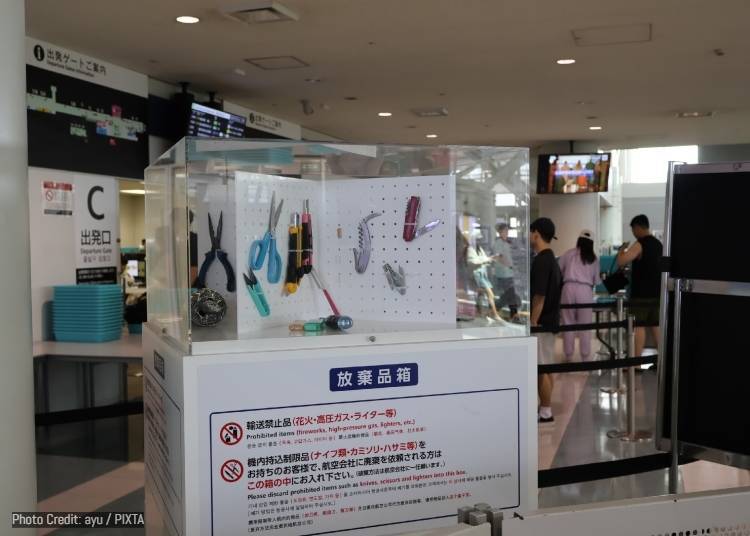
Items that can be used as weapons or contain large amounts of liquid are not permitted in carry-on baggage, but they can be placed in checked luggage and handed over at the airline counter.
Examples include:
・Scissors, knives, and blades (sharp-edged items)
・Tools such as screwdrivers (sharp or pointed instruments)
・Sports equipment like golf clubs and baseball bats (potentially dangerous)
・Liquids such as drinks, creams, lotions, perfumes, shampoo, shaving foam, and toothpaste when the container exceeds 100 ml
3. Items Allowed in Carry-on Baggage but Prohibited in Checked Baggage
Items that may generate heat or pose a fire risk are classified as dangerous goods if placed in checked baggage. These items must be carried in your hand luggage and cannot be stored in your suitcase.
For liquid items, each passenger may carry one resealable transparent plastic bag. The total capacity of all containers must not exceed 1 L, and each individual container must be 100 ml or less.
Examples include:
・Batteries used in cameras, mobile phones, and other electronic devices
・Portable power banks (for laptops and other devices)
・Electronic cigarettes
・Hand warmers (single-use warmers must be unopened; rechargeable warmers must be carried on board and cannot be checked)
・Lighters and matches (one per person maximum)
・Battery-powered hair styling tools
・Underwater lights that generate strong heat
Important rules for power banks and lithium batteries
Power banks must be carried in your hand luggage. Some airlines also prohibit placing them in overhead bins.
Capacity limits apply:
・100 Wh or below: No declaration required, permitted in carry-on baggage
・100 Wh–160 Wh: Declaration required, maximum of 2 units allowed
・Above 160 Wh: Not permitted on the aircraft
(Note: The lithium batteries in most smartphones, cameras, and small power banks fall under the 100 Wh limit.)
Latest safety reminder: Power banks must remain switched off during the entire flight
To ensure flight safety, many airlines, including major Asian carriers, now prohibit the use or charging of power banks and spare lithium batteries at any time during the flight. Please fully charge your devices before boarding and keep all power banks switched off while in the air.
4. Items Allowed in Both Carry-on and Checked Baggage

Some items are technically classified as hazardous materials, but they are permitted in both carry-on and checked baggage as long as they meet specific conditions.
Examples include:
・Plug-in hair styling tools and hair dryers
・Electric shavers
・Nail clippers and tweezers
・Smartphone chargers (AC adapters and USB chargers)
・Medical disinfectant sprays, cooling sprays, aerosol cosmetics, and deodorant sprays
(Each container must be 0.5 kg or 0.5 L or less; the total amount per person must not exceed 2 kg or 2 L)
Q&A: Common Questions About What You Can Bring Into and Out of Japan
Q: What items need to be removed during security screening?
A: To speed up the security check, please take the following items out of your bag or off your person and place them in the inspection tray:
・Coats, jackets, platform shoes, or boots
・Laptops, tablets, and other large electronic devices
・All metal items (such as belts, watches, necklaces, etc.)
・A transparent resealable bag containing any liquid containers
Some airports now use upgraded scanners that allow certain items to remain in your bag. Please follow the on-site instructions.
Q: Can I wear accessories like necklaces or watches through security?
A: Accessories are allowed on the plane, but to avoid setting off the metal detector, it’s best to remove necklaces, watches, belts, and other metal items before walking through the security gate and place them in the tray for inspection.
Q: Can I bring toothpaste, dry shampoo, or mascara on the plane?
A: Yes, but these items are classified as liquids, gels, or aerosols. To bring them in your carry-on, each container must be 100 ml or less, and all items must fit inside one clear, resealable plastic bag with a total capacity of no more than 1 L. Any container over 100 ml must go in checked luggage.
Q: Can I bring a lighter on the plane?
A: A lighter may be carried and must be on your person and cannot be checked. Each passenger may bring only one. Torch-type or windproof jet lighters are strictly prohibited both in carry-on and checked luggage.
Q: Can I bring hand warmers on the plane?
A: Single-use hand warmers (unopened) are allowed in both carry-on and checked luggage. Rechargeable hand warmers contain lithium batteries, so they must be carried on board and cannot be checked.
Q: Can kitchen knives or fruit knives be checked in?
A: Yes. All bladed items (including kitchen knives, fruit knives, scissors, and nail clippers) are strictly prohibited in carry-on bags and must be placed in checked luggage.
Q: What are the rules for umbrellas, selfie sticks, and tripods?
A: Foldable umbrellas may be carried on or checked. Long umbrellas must be checked. Selfie sticks and tripods can be brought on board if the tube diameter is under 1 cm and the folded length is under 60 cm. Anything larger must be checked.
Q: Can I bring food on domestic flights in Japan?
A: Yes. Domestic flights in Japan follow different liquid rules from international flights. Depending on the airline, you can usually buy drinks after security and bring them on board, and solid foods like bread, snacks, and cookies are generally allowed. Some low-cost carriers (LCCs) have their own policies, so check the airline’s website in advance. For domestic flights, liquids over 100 ml (such as water, tea, or juice) may also be carried on.
Leaving and Entering Japan: Updated Customs & Declaration Guide
Airlines may also have their own additional rules, so be sure to check each carrier’s prohibited-items list before you fly. Certain appliances cannot be taken out of Japan at all. Before shopping at big-box stores, double-check whether the electronics you plan to buy can be brought out of the country and whether they are compatible with your country’s voltage and plug standards. This will help you avoid spending money on items you can’t take home.
▼ Read more about arrival and departure procedures ▼
Streamline Your Arrival: Use Japan’s Electronic Customs Declaration

To speed up your entry into Japan, it is highly recommended to complete your immigration and customs declaration in advance through the Visit Japan Web system. Once you arrive at the airport, simply scan the generated QR code to pass through customs. This process is much faster than filling out paper forms at the airport.
▼ You May Also Be Interested In ▼

*Prices and options mentioned are subject to change.
*Unless stated otherwise, all prices include tax.
Popular Tours & Activitiess
Recommended places for you
-
Jujutsu Kaisen Takes Over JR East With a Wrapped Shinkansen This Winter
by: Guest Contributor
-
Japan’s Shinkansen Is About to Change Travel in an Unexpected Way
by: Guest Contributor
-
Strawberries, Style, and Tokyo’s Coolest Neighborhood: Winter Afternoon Tea in Kichijoji
by: Guest Contributor
-
This Winter, Godzilla Takes Over Haneda Airport
by: Guest Contributor
-
Ad
Discover the "Miraculous Forest" in the Heart of Tokyo: The Institute for Nature Study (9 Minutes from JR Meguro Station)
-
How to Get Don Quijote's Exclusive 2025-2026 Winter Gift (+Tax-Free Savings)
Inspiration for Accommodations
-
Enjoy Mt. Fuji from the Comfort of Your Room! Recommended Ryokan with Mt. Fuji View
-
Stay Near the Cherry Blossoms! Hotels for Cherry Blossom Viewing in Tokyo
-

Family-Friendly Hotels with Free Shuttle to Disneyland: Convenient Access for a Magical Stay
-
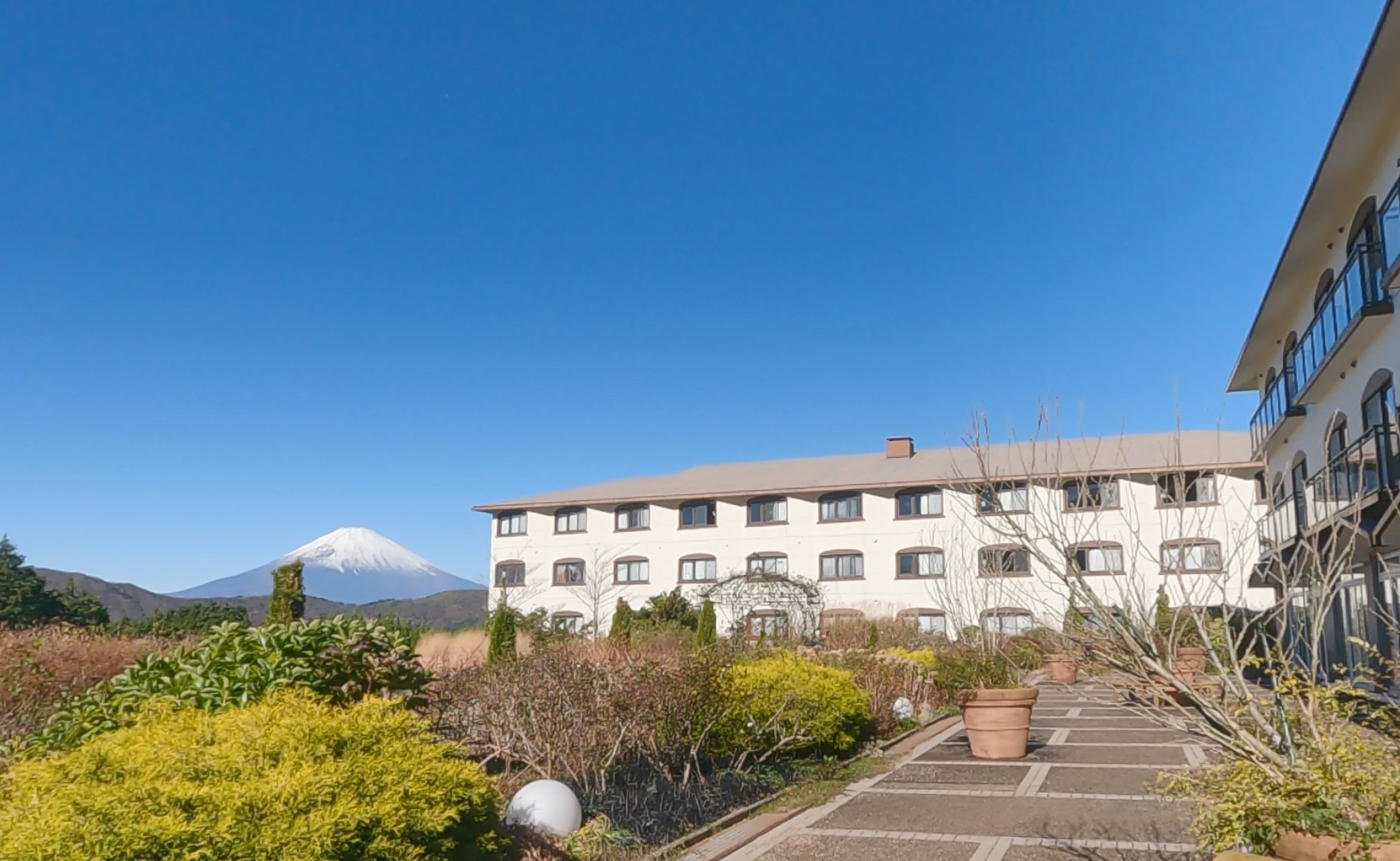
Top Ranked Hakone Hotels with Mt. Fuji View: Enjoy Stunning Scenery from Your Private Space
-
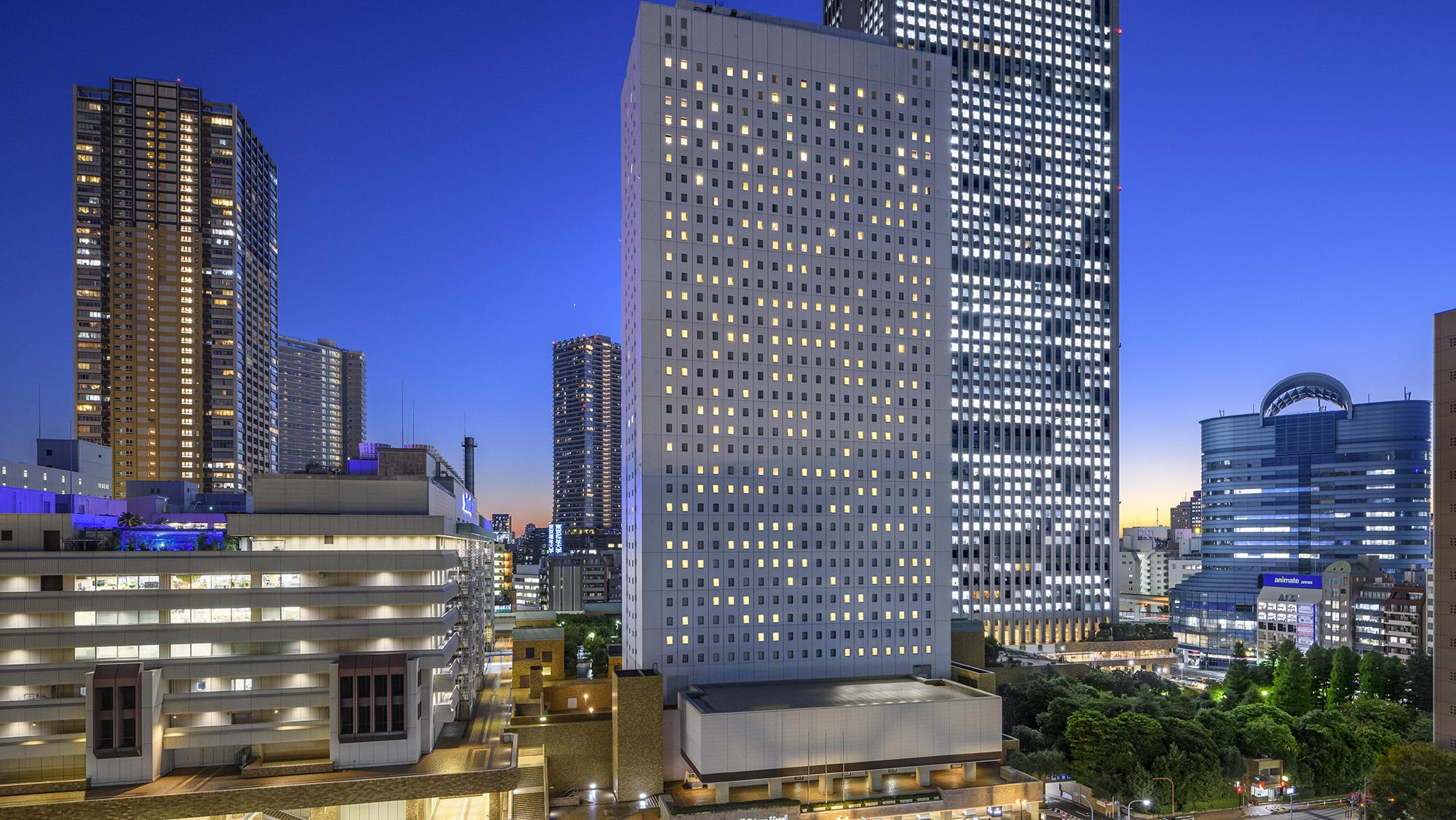
Convenient Tokyo Hotels with Airport Shuttle: Ideal for Families and Heavy Luggage
-
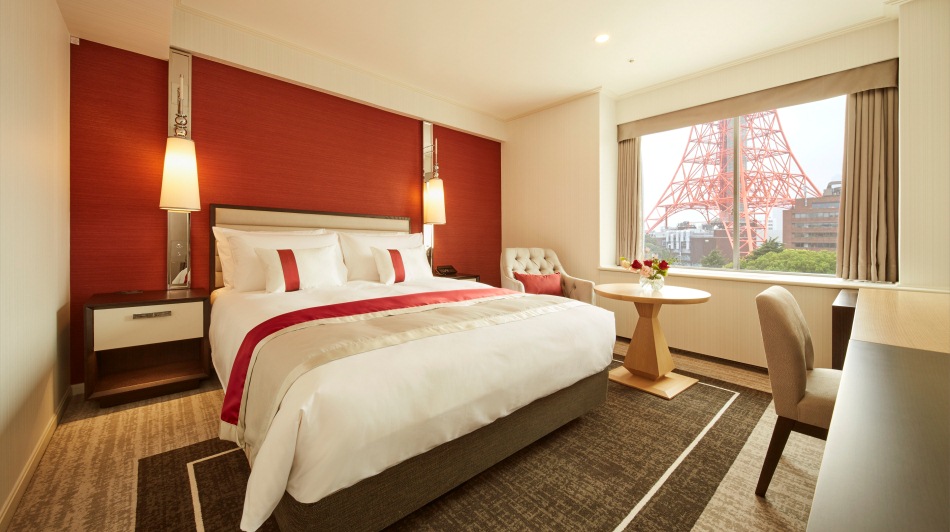
Stunning Tokyo Tower View Hotels: Enjoy Spectacular Scenery from Your Private Space
-
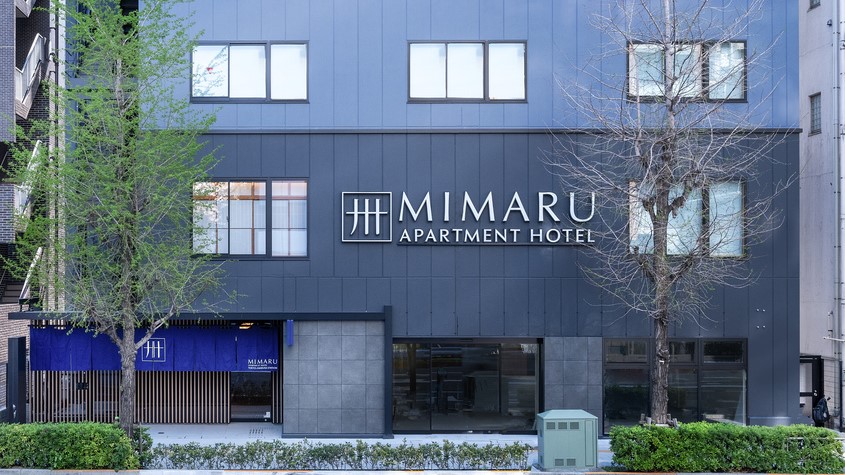
Convenient Asakusa Hotels with Kitchens: Ideal for Extended Family Visits
-
Experience Luxury: Hakone's 10 Best Five-Star Accommodations
-

Enjoy Mt. Fuji Autumn Leaves! Top Hotels Near the Popular Autumn Leaves Corridor
-

Experience Hakone Fall Foliage from Your Room with Stunning Views
-
Things to Do in Tokyo in August 2025: Summer Events, Festivals & More
by: Kaori Kimura
-
Spending Wonderful Time Alone in Shibuya - Free Cosmetics and a Hundred-Yen Bus!
-

Places to visit for your first time in Yanesen!
-
Ad

Japan’s Premier Electronics Retailers, Yodobashi Camera & BicCamera, Reveal Top Seiko Watches for Tourists
-
Guide to Tokyo's Old Quarter: 7 Quaint Spots in Yanesen!
-
Nihonshu Bar Fuksuke – No Matter where you are from, this Japanese Sake Connoisseur has the Right Drink for You!
- #best ramen tokyo
- #what to buy in ameyoko
- #what to bring to japan
- #new years in tokyo
- #best izakaya shinjuku
- #things to do tokyo
- #japanese nail trends
- #what to do in odaiba
- #onsen tattoo friendly tokyo
- #daiso
- #best sushi ginza
- #japanese convenience store snacks
- #best yakiniku shibuya
- #japanese fashion culture
- #best japanese soft drinks