






Every Fall, Giant Straw Creatures Take Over This Park in Japan
- Written by: LIVE JAPAN Editor
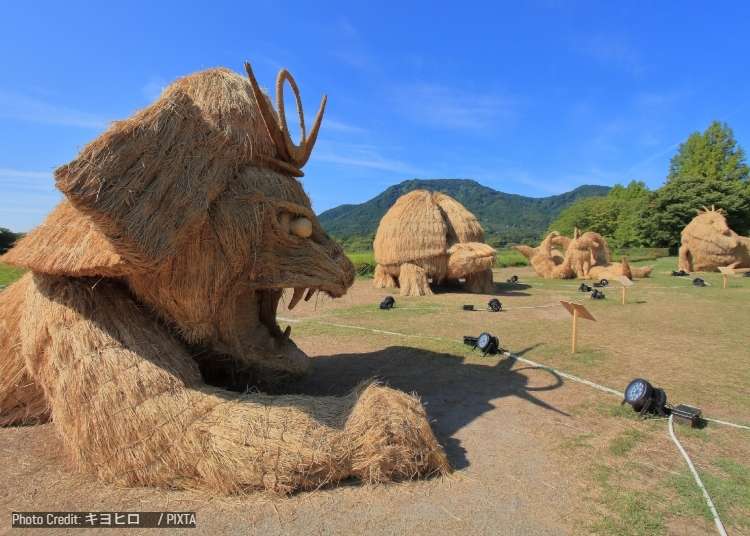
Every autumn, rice straw left behind after the harvest gets a rather unexpected second life in Niigata: it becomes giant animals.
The annual Wara Art Festival is back at Uwasekigata Park in Niigata City from August 29 to October 31, 2026, transforming locally sourced rice straw into five enormous sculptures created by university students and local volunteers. This year’s lineup is especially playful, with capybaras, a crab, a frog, a horse, and a rhino all appearing to enjoy one of the region’s favorite pastimes: soaking in hot springs.
Held against the rural landscape at the foot of Mt. Kakuda, the festival is one of Niigata’s more unusual autumn attractions and a fun excuse to venture beyond the city’s central sightseeing spots.
What is Niigata's Wara Art Festival?
Niigata is one of Japan’s best-known rice-producing regions, which also means plenty of rice straw, or wara, is left behind after the harvest.
The Wara Art Festival turns that agricultural by-product into enormous three-dimensional sculptures. The project grew out of cooperation between the former Iwamuro Village and Tokyo’s Musashino Art University, with the first straw artwork displayed in 2006. The event became an official Niigata City festival in 2008, and since 2009, the sculptures have been brought together at Uwasekigata Park.
The pieces are built around large frameworks, then bamboo and bundles of rice straw are attached to create their shapes and textures. Students work alongside local volunteers to build them, making the festival as much a community project as an outdoor art exhibition.
For 2026, students from both Musashino Art University and Nagaoka Institute of Design took part in the project.
2026's wonderfully weird theme: Animals having an onsen meeting
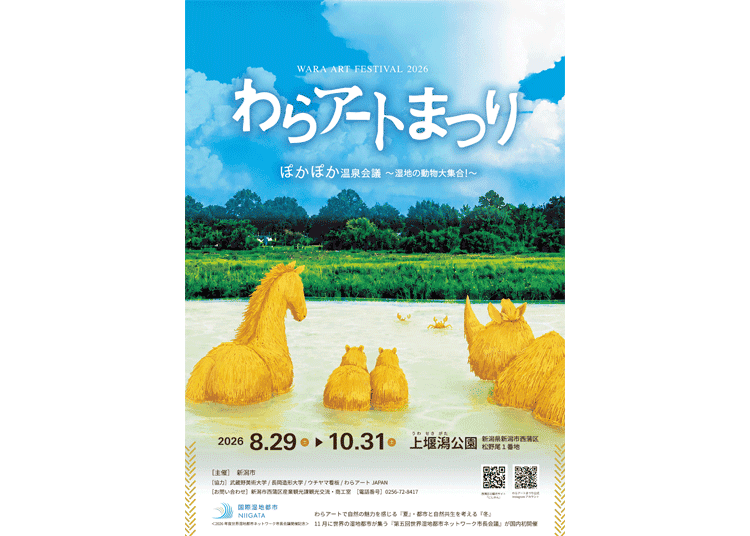
This year’s theme roughly translates to “Cozy Hot Spring Conference: Wetland Animals Assemble!”
There is actually a reason behind the unusual combination. Niigata City will host the fifth World Wetland City Network Mayors Meeting in November 2026, the first time the gathering has been held in Japan. The festival therefore chose animals associated with wetland environments as its subjects.
But Nishikan Ward and the surrounding area are also dotted with hot springs. So rather than simply creating five wetland animals, the artists imagined them traveling between local onsen and relaxing together.
The result is arguably one of the most charmingly specific themes Wara Art Festival has attempted yet.
Meet the five giant straw animals
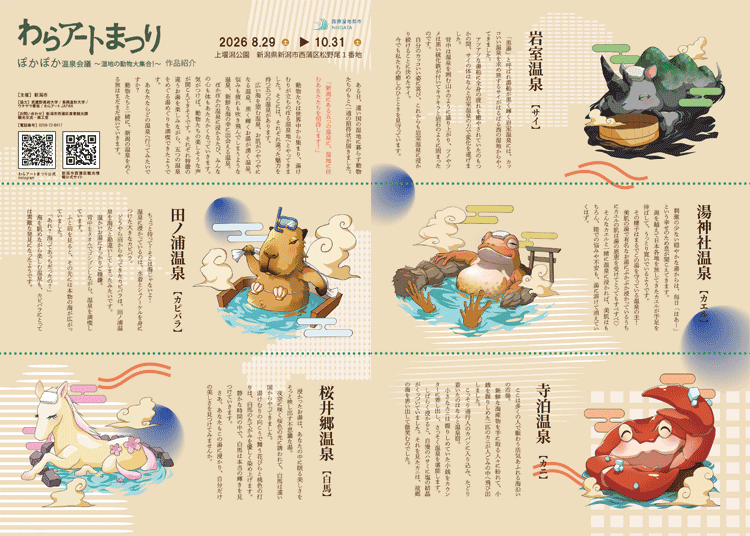
Five sculptures are spread around Uwasekigata Park in 2026, with each animal paired with a hot spring area in or around Nishikan.
Tanosawa Onsen Capybara
Possibly the star of this year’s festival is a huge capybara lounging contentedly in the straw-art equivalent of a hot spring. There is even a miniature storyline behind the sculpture: the capybara apparently arrived at the onsen after mistaking it for the sea. Its relaxed expression and rounded body also make it particularly well suited to the warm, textured appearance of rice straw.
Sakurai-go Onsen Horse
A horse represents Sakurai-go Onsen, adding a taller and more elegant silhouette to the lineup. The artists paid particular attention not only to the individual animals’ expressions and gestures, but also to incorporating characteristics of the different hot spring areas represented by the sculptures.
Iwamuro Onsen Rhino
One of the bulkier animals in the group is a rhino representing Iwamuro Onsen, one of Nishikan’s best-known hot spring districts. Its heavy proportions make a natural match for the festival’s large-scale construction style, where layers of straw can be used to build up remarkably muscular-looking forms.
Yu-jinja Onsen Frog
A frog taking a leisurely soak represents Yu-jinja Onsen. Photos from the festival show the frog wearing an especially satisfied expression, reinforcing the somewhat surreal premise that these enormous wetland creatures have gathered in Niigata purely to relax.
Teradomari Onsen Crab
Nagaoka Institute of Design students created the giant crab representing Teradomari, an area strongly associated with seafood along the Sea of Japan coast. The students deliberately emphasized the contrast between the crab’s imposing claws and its peaceful expression as it takes a break in the hot spring.
Together, the five works turn the park into something between an outdoor sculpture garden and a very unusual animal spa.
See the sculptures illuminated after dark
The straw animals are impressive in daylight, but visitors arriving on selected evenings can see a completely different version of the festival.
From August 29 through September 27, the sculptures and surrounding park paths are illuminated from 5:30 PM to 7:30 PM on Saturdays, Sundays, and national holidays.
The warm lighting brings out the layered textures of the straw while giving the oversized creatures an almost theatrical appearance.
If your schedule allows, arriving in the late afternoon is a particularly good option. You can see the works in daylight, explore the park, then stay as the illumination begins.
Food, music, and a special September event
There is more happening around the sculptures on several dates during the festival.
The Nishikan Market takes place on August 29 and 30 and again from September 21 to 23, from 10 AM to 2 PM. Stalls sell local agricultural products, sweets, food, handicrafts, and other goods from Nishikan and the wider Niigata City area.
September 21 to 23 also brings the special “Wara to, Anata to, Ongaku to.” event at the Wara Art Festival. Combining the straw artworks with live performance stages and food trucks, it runs from 10 AM to 2 PM each day.
For travelers visiting during Japan’s September holiday period, these three dates will therefore offer the liveliest version of the festival.
How to get to the Wara Art Festival
The festival takes place at Uwasekigata Park in Nishikan Ward, Niigata City.
From JR Maki Station, the park is about a 15-minute drive. From the Maki-Katahigashi Interchange on the Hokuriku Expressway, the drive takes roughly 20 to 25 minutes.
Travelers without a car have another useful option on weekends and national holidays. The Nishikan Sightseeing Loop Gurun Bus connects JR Maki Station with attractions around Nishikan, including Uwasekigata Park. The bus runs on Saturdays, Sundays, and national holidays through October 31, 2026, and the Uwasekigata Park stop is around a one-minute walk from the festival grounds.
The loop also serves destinations including Iwamuro Onsen, Cave d’Occi Winery, Yahiko Station, and Yahiko Shrine, making it possible to turn the straw-art festival into a fuller day trip around western Niigata.
- Dates: August 29 to October 31, 2026
- Venue: Uwasekigata Park
- Admission: Free
- Light-up: Saturdays, Sundays, and national holidays through September 27, 5:30 PM - 7:30 PM
- Nishikan Market: August 29-30 and September 21-23, 10 AM - 2 PM
- Official website (in Japanese)
- Local sightseeing information (in Japanese)
- The giant wara art is impressive in its own right, but the setting adds to the experience, with spacious park scenery and Mt. Kakudayama rising in the background.
- Consider combining your visit with a stay near Cave D’Occi Winery, or adding it as a side trip when exploring Niigata City or Sado Island.

-
Uwasekigata Park上堰潟公園
-
Address
1 Matsunoo, Nishikan Ward, Niigata, 953-0015
View Map
-
Address
1 Matsunoo, Nishikan Ward, Niigata, 953-0015
A very Niigata take on autumn art
There are plenty of places in Japan to see autumn leaves or seasonal flower displays, but considerably fewer where you can encounter an enormous capybara enjoying an imaginary hot spring.
What makes Niigata’s Wara Art Festival particularly fun is that the spectacle remains closely connected to the landscape around it. The sculptures start with a material produced by the region’s rice fields, are built by students and residents, and in 2026 even incorporate the area’s wetlands and onsen culture into their designs.
For travelers exploring Niigata in early autumn, it is an easy-to-understand introduction to the region, just delivered in the form of five extremely large straw animals.
- Area
- Category
*Prices and options mentioned are subject to change.
*Unless stated otherwise, all prices include tax.
Popular Tours & Activities
Recommended places for you
-
Aomori Nebuta Festival
Japanese Festivals (Matsuri)
Aomori, Hirosaki And Hachinohe
-
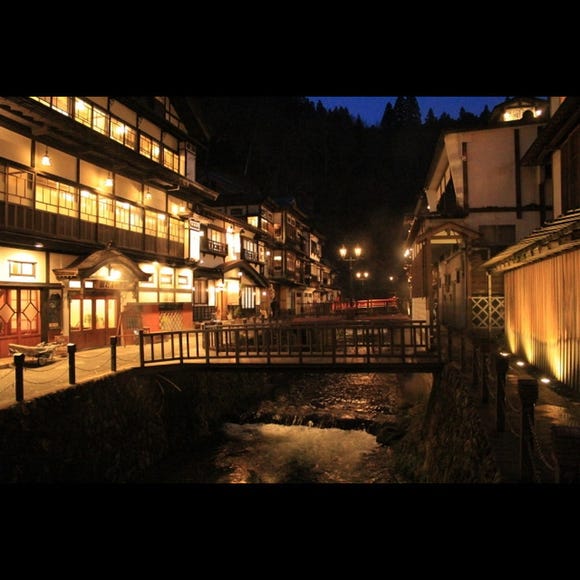
Ginzan Onsen
Hot Springs (Onsen) & Bath Houses (Sento)
Surrounding Areas Of Yamagata
-
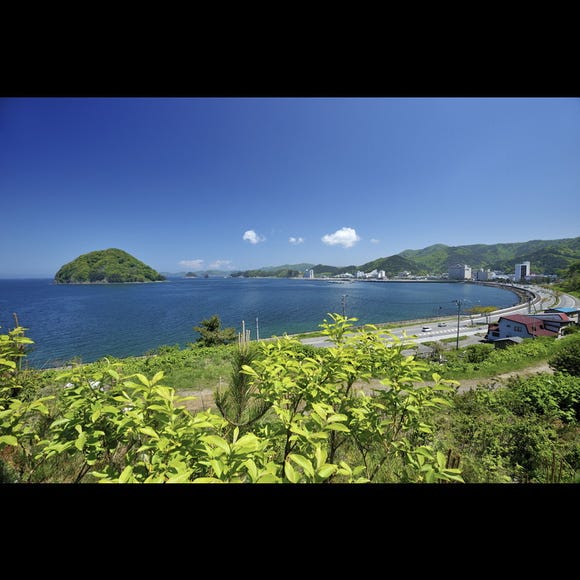
Asamushi Onsen
Hot Springs (Onsen) & Bath Houses (Sento)
Aomori, Hirosaki And Hachinohe
-
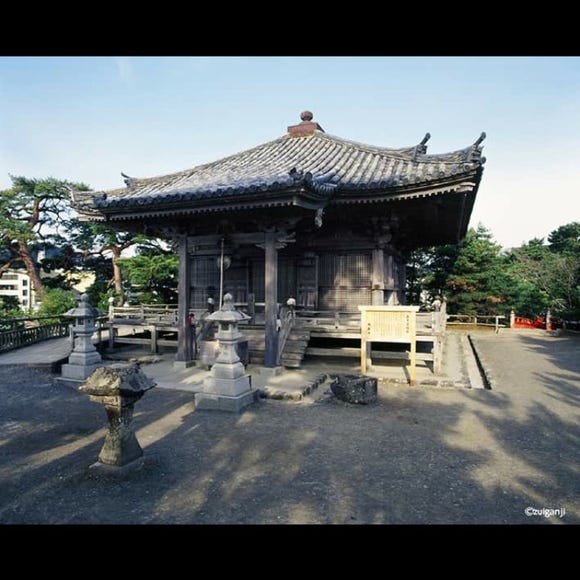
Zuiganji Temple
Temples
Sendai And Matsushima
-
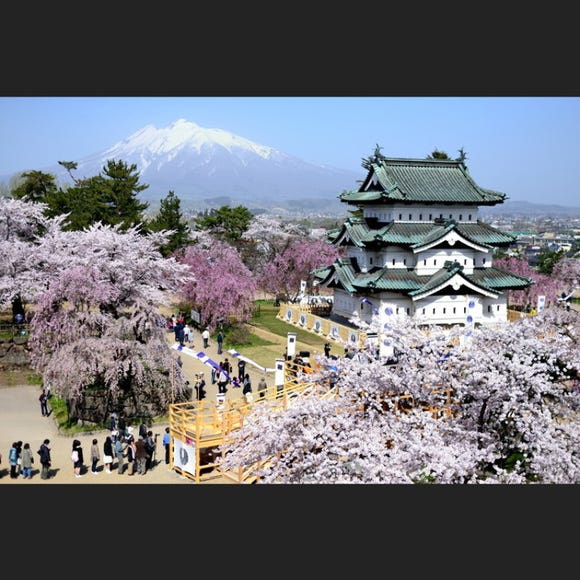
Hirosaki Park
Parks
Aomori, Hirosaki And Hachinohe
-
Koiwai Farm
Other Nature
Morioka, Hiraizumi And Hachimantai
-

Top-Booked: Must-Try Sendai Gyutan & Yakiniku in Sendai for First-Time Visitors
by: Guest Contributor
-

Hotel Mazarium: Stay In the Heart of Morioka at This Atmospheric Hotel
by: Timothy Sullivan
-
Tohoku's Best Value Onsen Ryokan: 10 Hidden Hot Spring Gems from Sendai to Aomori and Niigata
-

6 Morioka Souvenirs Worth Buying near the Station: An Editor's Picks from Iwate
by: Yukiko Honda
-
Why Is There a Giant Moai Statue in Japan? A Powerful Story Awaits in Minamisanriku
by: Timothy Sullivan
-
Sendai & Miyagi: 10 Recommended Apartment Hotels Perfect for Road Trips and Local Experiences
-
Koiwai Farm Guide: Explore, Dine, and Play at Iwate's Top Agritourism Spot
-
10 Must-Visit Places for Autumn Leaves in Tohoku: Naruko Gorge, Geibikei Gorge & More (2026)
by: Guest Contributor
-

Fun Things to Do in Aomori in Fall (September/October/November): Events, Festivals & More!
by: Kei Suzuki
-
Kichijoji – Explore Tokyo’s Top-Rated Stylish Suburb in Half a Day!
-
Fun Things to Do in Morioka in Fall (September/October/November): Events, Festivals & More
by: Kei Suzuki
-

3 Famous Ramen Shops in Yamagata - Japan's "Ramen Prefecture"!