




Japan Ski Lift Passes for Beginners (What to Know Before You Go)
- Written by: Marco Blasco
When coming to Japan for your ski trip, you’ll need access to the mountain. That’s where lift passes come in. This guide breaks down the main types of lift passes in Japan, how they work, and what beginners should choose.
What is a lift pass?

A lift pass, sometimes called a lift ticket, is your admission pass to the ski resort’s lifts.. Without one, you won’t be able to ride chairlifts or gondolas, which means no skiing or snowboarding.
Lift passes can often be purchased online beforehand or in person when you arrive. At some resorts, they may be a part of a hotel package so it’s a good idea to ask and research your options.
Japanese ski resorts offer a wide variety of lift pass options, which can be confusing for first-timers. These choices are designed to suit different skiing styles, schedules, and budgets.
Which type of lift pass should you choose?
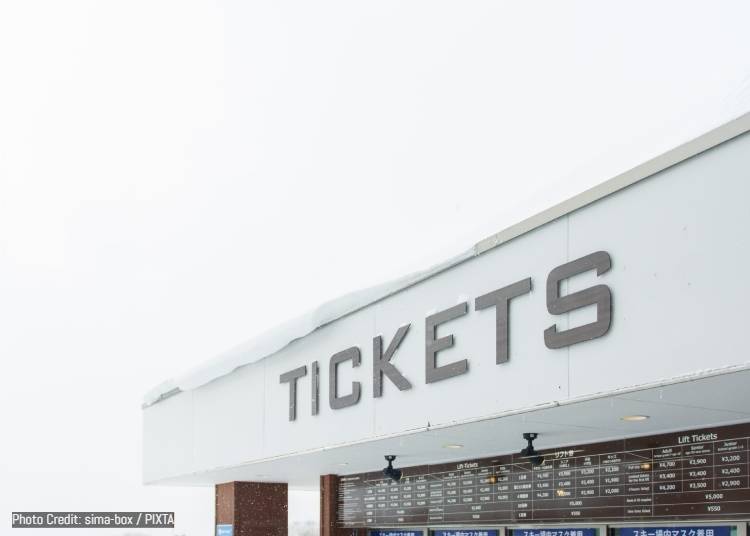
Lift passes will vary by resort, though I’ve laid out the basic types below. Be sure to check with your resort, however, to see exactly what they offer. Always check your specific resort’s website for details.
- Day Passes
- ・Full-day pass gives you unlimited lift access from opening until closing.
・Good for: Most skiers, especially beginners who want flexibility.
・Note: Prices vary significantly by resort, season, and whether you buy online vs. at the ticket window. Check your specific resort's website for current pricing.
- Half-Day Passes
- ・Can be purchased for morning or afternoon access.
・Usually cheaper than full-day passes.
・Good for: If you're only skiing part of the day, arriving late, or leaving early.
- Multi-day Passes
- ・For example: 2-day, 3-day, or 5-day passes offering consecutive days of skiing.
・Good for: Week-long trips where you're skiing multiple days in a row.
・Note: At many resorts, these types of passes must be used on consecutive days. Large resort areas like Niseko and Hakuba often offer “all-mountain” passes covering multiple resorts in one valley.
- Single-use Tickets
- ・A ticket for one ride up a specific lift. After that ride, the ticket is done.
・Good for: Absolute beginners who only want to try one or two runs, or getting one or two more runs in at the end of the day.
- Multiple-use Tickets
- ・Pre-purchase a set number of rides (like a 10-ride pass). Use them throughout the day as needed.
・Good for: Beginners who want to take breaks between runs without wasting an unlimited day pass.
- Point System Passes
- ・Certain resorts like Niseko use a point system where different lifts cost different points. You buy a card loaded with points and each lift deducts points.
・How it works: You buy a certain number of points and then different options like the gondola or the lifts cost a certain number of points.
・Good for: Flexible skiing where you're not doing full days.
- Hourly Passes
- ・Some resorts offer different hourly passes that track in hourly blocks. For example, if you go through the gate at 9 AM, you’ll have unlimited access until 10 AM. When that hour is up and you pass through the gate again, it’ll deduct another hour.
・Good for: People taking long breaks, splitting time between multiple resorts, or casual skiers.
How Do Lift Passes Work in Japan?

Most Japanese ski resorts use either IC card systems or paper tickets.
IC CARDS / RFID SYSTEM
This system is common at large and international resorts and is very convenient.
How it works:
• Purchase your pass at the ticket window or online
• Receive an IC card (a plastic card about the size of a credit card usually)
• Put the card in your jacket pocket or lift pass holder.
• At the lift, there's a gate with a sensor. When you go through the gate, it will automatically scan your card
• Gate opens if your pass is valid
• No need to take the card out of your pocket
Pro Tips:
Most sensors are on the left side of the gate, so store your pass in a left-side pocket for smooth scanning.
Many IC cards require a deposit of 500 to 1,000 yen. Return the card at the end of your trip to get your deposit back.
Important: Keep the card away from phones, credit cards, or foil-wrapped items, as these can interfere with scanning.
PAPER TICKETS
Smaller or more traditional resorts still use paper tickets.
How it works:
• Purchase ticket at window
• Receive a paper ticket
• Most ski jackets will have a clear ski card holder on the sleeve or in the lining of the jacket to keep the pass safe from getting wet. You can also buy a separate holder if your jacket doesn’t have one. Place the lift pass in this pocket.
• Staff at lift will visually check your ticket. Depending on the resort you may have to take it out for them to punch or stamp it.
Pro Tip:
Many ski jackets in Japan include a clear sleeve window for lift tickets. If yours does not, pass holders are sold at resort shops for a few hundred yen.
Important:
Do not lose your lift pass! Usually you will have to purchase another one if you misplace it. Take a photo of you with your pass, as if you lose it, the resort may be able to reissue it using the ID number.
Types of Ski Lifts You’ll Encounter
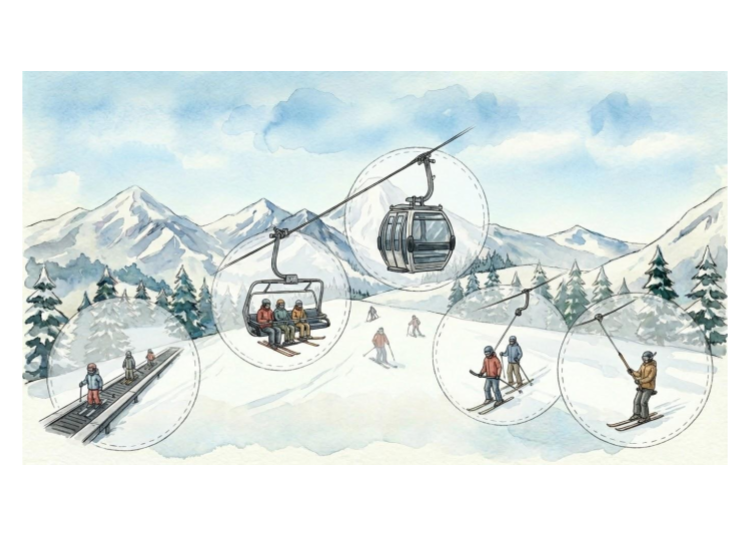
Magic Carpets
These are essential conveyor belts, where all you need to do is stand on them while they take you up the mountain. These are the best for absolute beginners as you do not need to learn how to unload.
Chairlifts
These are the most common lift type that usually fit around 2-6 people. With chair lifts, you’ll wait in line until your turn comes and then stand in front of the chair as it rotates around and toward you. The seats hang from a cable, and when it comes beneath you, you’ll sit down on it. If there is a safety bar, you’ll pull that down in front of you after you are seated. When the lift comes to the top, you’ll have to unload and usually ski or snowboard down a small hill. This does take some skill, balance, and getting used to, so be aware of this if it is your first time.
Gondolas
These are enclosed cabins that will take you up to the top of the mountain. Generally, you’ll carry your skis or snowboard and the gondola will arrive at another lodge type place where you can put your gear back on and get situated.
T-Bars / J-Bars
These are essentially long hook-like lifts that you place between your legs or behind one leg. It will pull you up the mountain along your skis, so they can be a little bit tricky for beginners.
Tips for Beginners
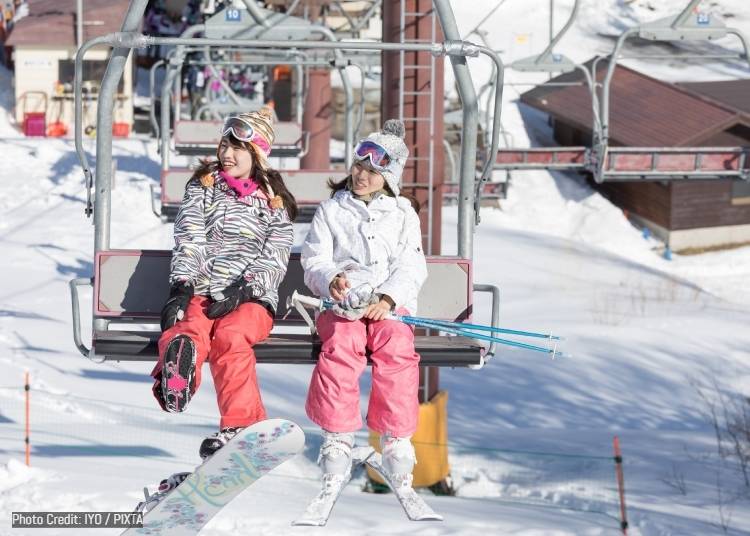
If you are an absolute beginner, I would recommend getting a shorter pass (like a half-day pass) to test out how you feel on the mountain first. If you plan on skiing for multiple days, this is a great way to get a feel for things without tiring yourself for the rest of the trip.
Also, be sure to check the weather. In whiteout conditions or on days with very high winds, some lifts will close. You don’t want to buy a full-day pass and then realize you can’t use it.
Some of the popular resort regions are part of multi-resort areas, and so their passes work for different resorts as well. Be sure to check this out as it can be fun to have more variety and check out other resorts!
There may also be different types of discounts for different seasons, for children, or as part of multi-day passes or packages. So, just be sure to do your research in order to get the best deal possible.
Lift Pass Etiquette & Safety Tips
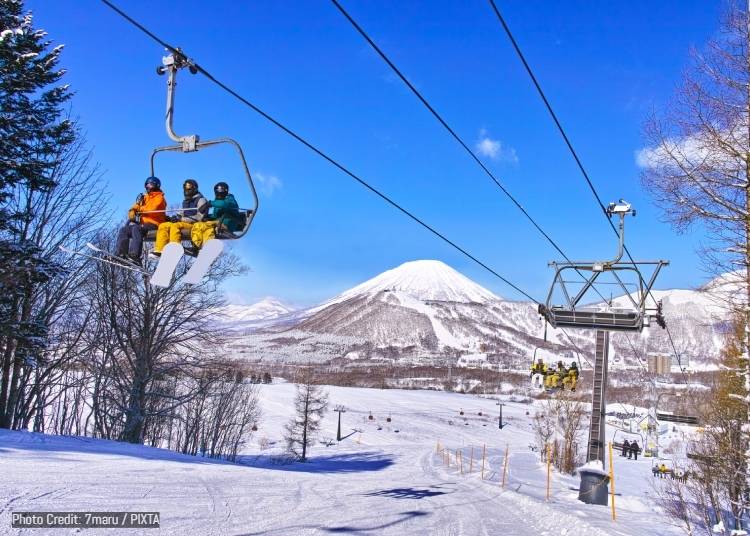
A lot of the etiquette surrounding ski lifts is common sense, and it goes without saying to be patient and wait your turn in line. Popular resorts will draw big crowds during the peak seasons, so being orderly and polite allows everyone to enjoy themselves and stay safe.
That being said, here are some quick tips to follow.
- In the Lift Line:
- ・Do not cut in line and wait patiently
・Have your pass ready to scan
- On the Chairlift:
- ・Keep skis or snowboard tips up (don't drag on ground or hit people below)
・In Japan, lowering the safety bar immediately is standard etiquette
・Don't rock or bounce the chair
・Watch for the unloading area
・Be extra careful with your phone. Dropping it into deep snow under a lift usually means it’s gone until spring.
- Unloading:
- ・Get off and move away immediately—don't stop in the unload zone
・People behind you are coming and can't stop easily
Figuring out the lift system can be a bit tricky for first timers. While it’s easy enough to buy a pass, getting on one and unloading can be difficult. It’s always helpful to watch a video or a demonstration to see how it’s done as well. But hopefully this guide gave you some quick tips on what to expect, and how to find lift passes that suit your needs.
Enjoy your time on the mountain, and for more tips, guides, and information about skiing in Japan, check out our other articles!

Marco Blasco is an American writer and editor living in Tohoku, Japan. After moving to Japan from the United States more than four years ago, Marco taught English in a snowy town before moving on to start his writing and editing career. Currently, he edits and proofreads light novels in translation, and writes articles about travel, Japanese culture, and the JET Program. In his free time, he writes novels, reads mostly science fiction and fantasy books, and tries to see as much of the Japanese countryside as he can.
- Area
- Category
*Prices and options mentioned are subject to change.
*Unless stated otherwise, all prices include tax.
Popular Tours & Activities

Recommended places for you
-
Appealing
Shirogane Blue Pond (Aoiike)
Rivers, Lakes & Canyons
Furano / Biei / Sounkyo
-
Farm Tomita
Other Nature
Furano / Biei / Sounkyo
-
Appealing
Sapporo Ramen Yokocho
Ramen
Sapporo / Chitose
-
Appealing
Rukku and Uohei
Izakaya
Sapporo / Chitose
-
Appealing
Mt. Hakodate Observatory
Forests & Mountains
Hakodate
-
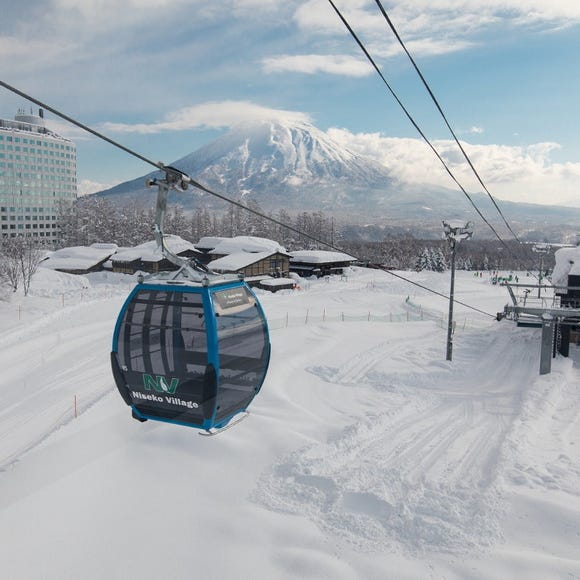
Niseko Village Ski Resort
Skiing & Snowboarding
Niseko / Rusutsu
-

Feel the Power of Giant Draft Horses Racing with Iron Sleds at Banei Tokachi (Obihiro Racecourse)
by: Guest Contributor
-
10 Recommended Apartment Hotels in Hakodate for Families & Groups
by: Sae Haneda
-
Hokkaido for Travelers from India: A Complete First-Trip Guide
by: Himanshi Shah
-

Hokkaido's Best 10 Budget Onsen Stays (Ryokan & Hotels From 20,000 Yen a Night)
-
Experience 'Ghost of Yotei' IRL! See Why Niseko is The Ultimate Summer Escape
-
Romantic Places in Hokkaido: Where to Honeymoon Across the Seasons
by: Himanshi Shah
-
Kamui Ski Links Guide (2025-2026): Northern Hokkaido's Largest Resort for Powder, Tree Runs, and Stunning Scenery
by: Hide
-
Tokyo Train & Subway Guide: Navigate the City Like a Pro (JR, Subways, IC Cards & Passes)
-
8 Unfamiliar (But Totally Normal) Customs in Japan!
-

5 Reasons You'll Love the Luxuries of Rusutsu Resort – Japan's Best Ski Area!
-

Japan Ski Packing List: Everything You Need for the Powder
by: Marco Blasco
-
Rusutsu Resort Guide (2025-2026): Three Peaks and Epic Powder Skiers & Snowboarders Will Love
by: Hide
- #best sushi hokkaido
- #things to do hokkaido
- #best ramen sapporo
- #what to bring to japan
- #new years in tokyo
- #what to buy in ameyoko
- #japanese nail trends
- #what to do in odaiba
- #onsen tattoo friendly tokyo
- #daiso
- #best sweets otaru
- #japanese fashion culture
- #best nature furano
- #japanese convenience store snacks
- #best japanese soft drinks