



Planning a Trip to the Nagaoka Fireworks Festival: Inside One of Japan's Biggest Summer Events
- Written by: LIVE JAPAN Editor
If you ask people in Japan to name the country’s most spectacular summer events, the Nagaoka Fireworks Festival (長岡まつり大花火大会) almost always comes up. Held every year along the Shinano River in Niigata Prefecture, this legendary event is considered one of Japan’s “Top Three Fireworks Festivals,” alongside Omagari in Akita and Tsuchiura in Ibaraki.
But Nagaoka is not just another summer fireworks show.
Originally launched in 1946 following the devastating August 1, 1945 Nagaoka air raid, the festival began as a memorial and prayer for peace. Over the decades, it has also come to symbolize recovery and resilience, especially after the 2004 Chuetsu Earthquake. Today, many Japanese people see Nagaoka not simply as entertainment, but as an emotional night of remembrance, hope, and community.
The result is one of the most breathtaking fireworks experiences in the world. It is also one of the most difficult for first-time visitors to plan.
From lottery-only tickets and sold-out hotels to brutal summer heat and massive crowds, here is everything first-timers should know before attending the Nagaoka Fireworks Festival.
What Makes the Nagaoka Fireworks So Famous?
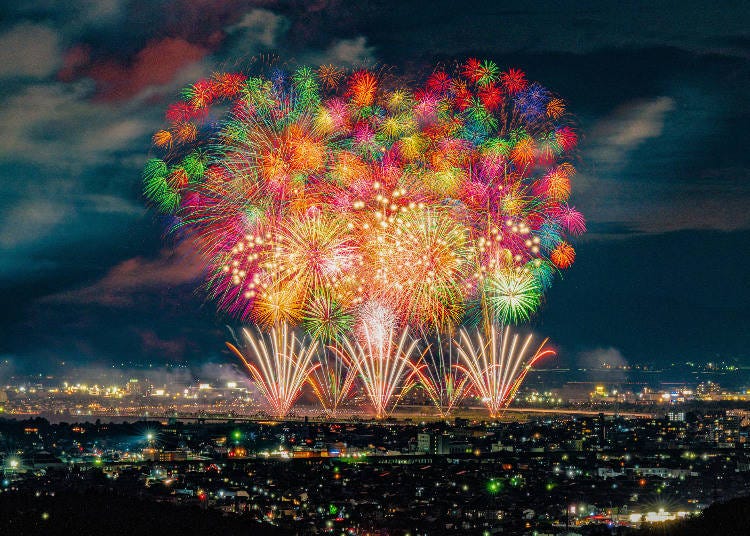
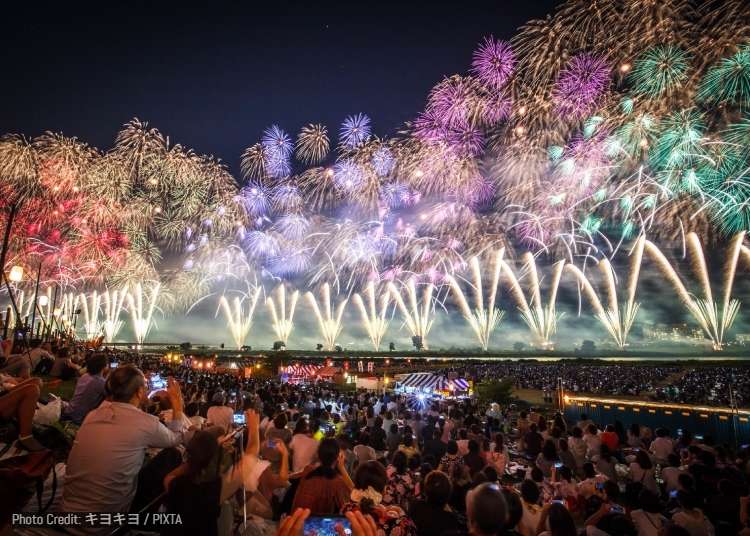
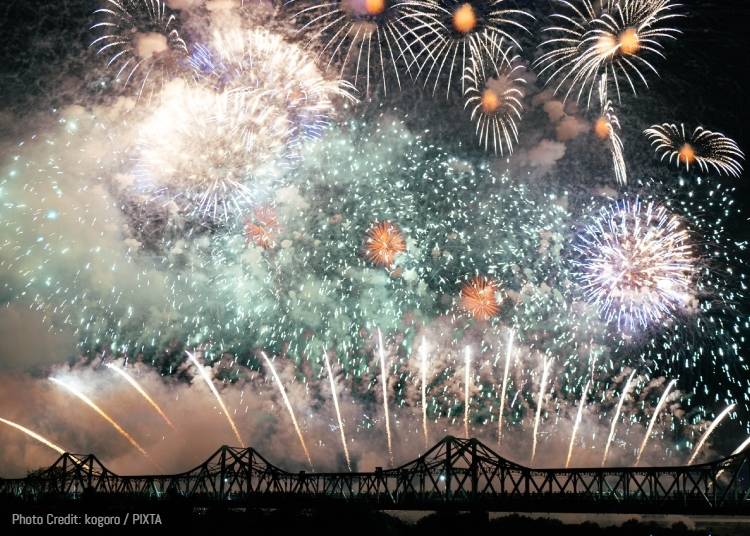
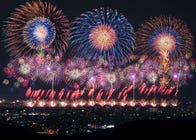
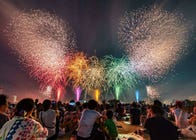
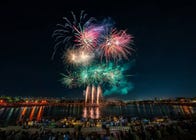
The festival takes place over two nights and launches roughly 20,000 fireworks shells in total. While many fireworks festivals in Japan focus on rapid-fire spectacle, Nagaoka is famous for massive synchronized sequences that fill the entire width of the river. These are the moments everyone comes to see.
White Chrysanthemum Fireworks (白菊)
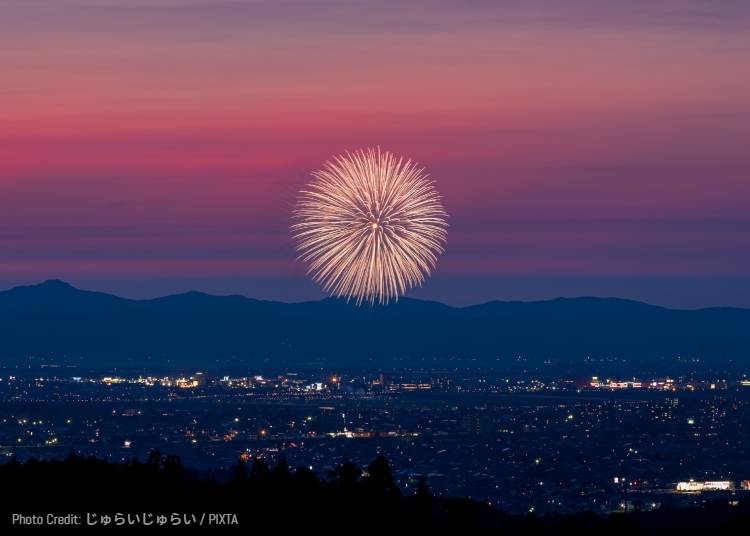
Each year, the opening segment features three shiragiku (white chrysanthemum) fireworks launched in remembrance of those lost during the Nagaoka air raid.
Unlike the loud, colorful celebratory sequences elsewhere in the program, the atmosphere during these fireworks becomes noticeably quieter and more reflective. It is one of the clearest reminders that Nagaoka is as much a memorial event as a summer celebration.
The Sho-Sanjakudama (正三尺玉)
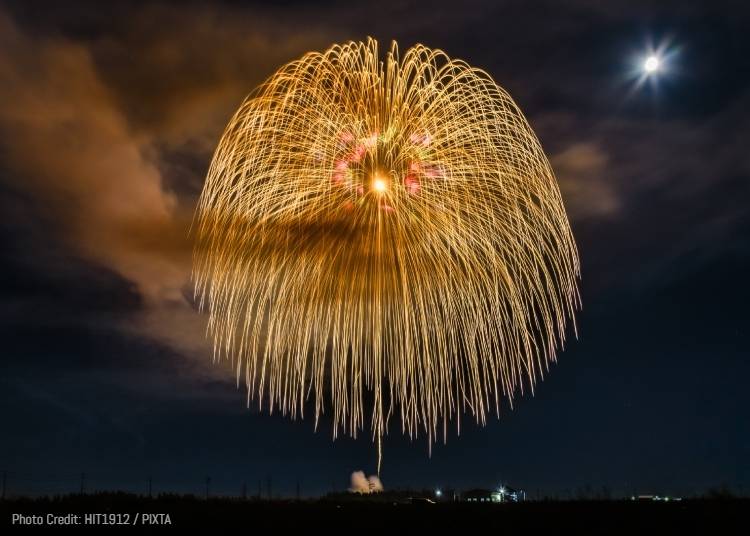
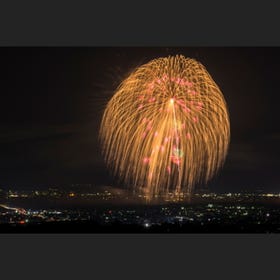
One of Nagaoka’s signature moments is the launch of the enormous Sho-Sanjakudama, a gigantic 300-kilogram shell that explodes into a chrysanthemum-shaped burst roughly 650 meters wide.
You do not just hear it. You feel it physically in your chest.
The shell has become one of the festival’s defining symbols, and 2026 marks the 100th anniversary of its first launch.
The Phoenix (復興祈願花火フェニックス)
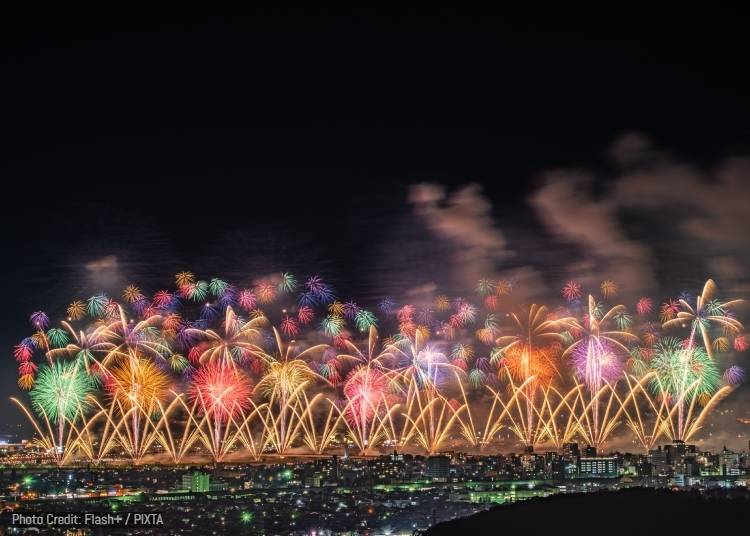
For many attendees, this is the emotional climax of the night.
Stretching nearly 2 kilometers across the sky, the Phoenix sequence launches wave after wave of golden fireworks synchronized to Ayaka Hirahara’s hit song, Jupiter. Created after the 2004 earthquake, it symbolizes recovery, hope, and rebuilding.
The scale is difficult to describe until you experience it in person. The fireworks feel less like explosions and more like a glowing wall of light rolling across the river.
The Niagara Falls (ナイアガラ)
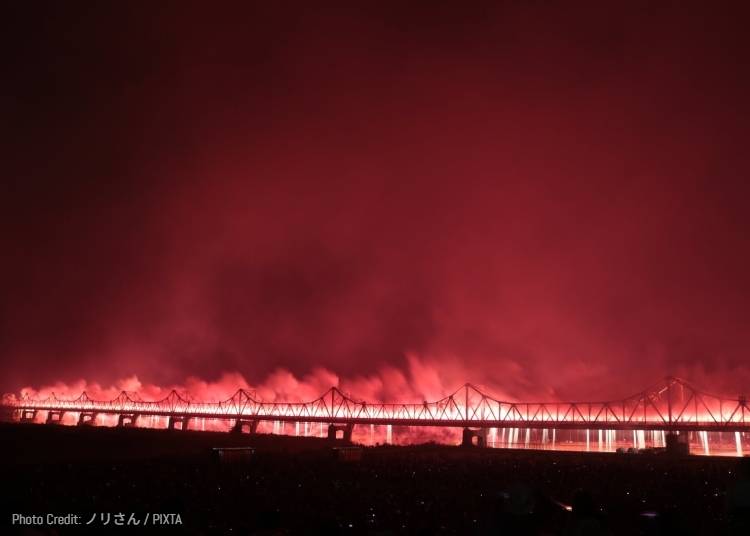
This spectacular sequence creates a glowing curtain of golden sparks stretching roughly 650 meters across the riverbank, resembling a giant waterfall cascading into the darkness below. It is one of the festival’s most photogenic moments.
The Ticket Situation: What First-Timers Need to Know
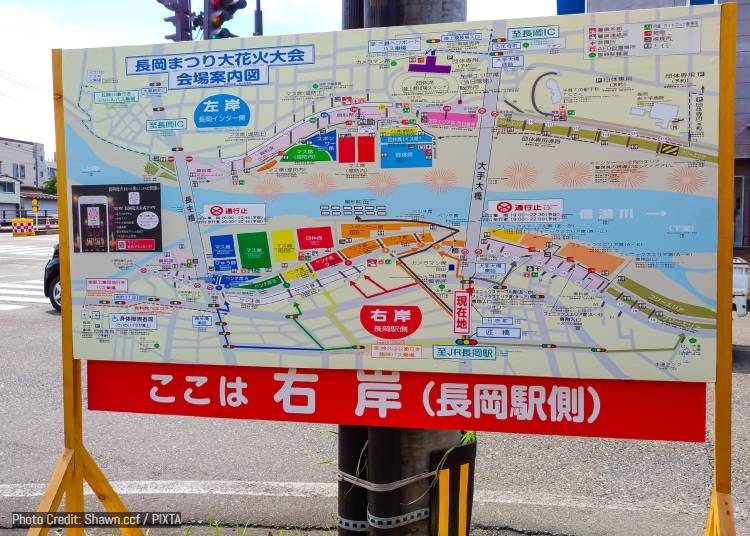
Here is the reality that many overseas visitors do not realize until it is too late: getting tickets for Nagaoka is extremely competitive.
All official viewing areas are now reserved paid seating, and tickets are generally distributed through lottery systems. Prime riverside seats can disappear almost immediately.
International visitors may also face additional hurdles:
・Japanese ticketing platforms sometimes reject overseas credit cards
・Some resale systems require Japanese phone numbers or addresses
・Nearby hotels often sell out months in advance
An official international ticketing site is usually available around May, but demand remains intense.
For many overseas travelers, bundled tour packages are honestly the easiest option.
Tour packages from companies like KKday, Klook and other operators often include:
・Round-trip Shinkansen or bus transportation
・Reserved fireworks seating
・Hotel accommodation
・Staff guidance
For travelers unfamiliar with Japanese event logistics, this can dramatically reduce stress.
- What it is: This lottery is for the remaining seats left over from the Nagaoka citizen advance sales.
- Application Period: May 25 at noon JST until June 8 at 5:00 PM.
- How to Apply: Applications are accepted via the internet only. You can find more info at the official ticketing website here.
- Results: Lottery results will be announced via email on June 17th.
- Ticket Delivery: Tickets will be sent out sequentially starting in late June.
2026 Nagaoka Fireworks Tour Packages
-
 3-Day Nagaoka Fireworks Tour: Green Car Shinkansen Travel & Luxury Onsen Stay at Shiratama no Yu Izumikei
Details & Bookings (KKday) ▶
(Image: KKday) -
 Nagaoka Fireworks 2-Day Tour (Includes Shinkansen, accommodation at Naeba Prince Hotel, and reserved seating tickets)
Details & Bookings (KKday)▶
(Image: KKday) -
 2 Day Nagaoka Fireworks Festival Bus Tour from Tokyo
Details & Bookings (Viator)▶
(Image: Viator) -
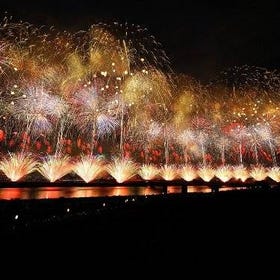 2 Day Nagaoka Fireworks Tour with Premium Chair Seating
Details & Bookings (Viator) ▶
(Image: Viator)
Where Should You Stay?
Many first-time visitors assume they should stay in Nagaoka itself. Unfortunately, hotels near the venue can sell out almost instantly. Instead, many experienced attendees stay in Niigata City, Echigo-Yuzawa, Takasaki, or even Omiya.
Some people even spend the night near the station and return the following morning after crowds clear.
First-Timer Survival Tips
Arrive Early
If you are not joining a tour, be aware that traffic restrictions and crowd-control measures begin well before the fireworks start.
Most attendees arrive between 3 PM and 6 PM, meaning you may spend hours sitting outdoors in intense summer heat before the show even begins.
Temperatures can remain around 28–32°C (82–90°F) even after sunset, and humidity is often extreme.
- Water
- Cooling wipes
- Sunscreen
- Portable fan
- Small towel
- Insect repellent

Buy Food Before Reaching the Venue
Convenience stores near the venue become incredibly crowded and often sell out of food and drinks early.
Many experienced attendees buy bentos, snacks, and drinks before arriving in Nagaoka or at Tokyo Station before boarding the Shinkansen.
Local Niigata specialties worth trying include: Niigata rice onigiri, hegi soba, sasa dango, local sake.
Leave Umbrellas at Home
Umbrellas and parasols are generally prohibited during the fireworks because they block views. If rain is forecast, bring a raincoat or poncho instead.
Prepare for the Exit Chaos
When hundreds of thousands of people attempt to leave at the same time, movement becomes extremely slow.
It can easily take:
・2–3 hours to reach the station
・over an hour just to move through pedestrian routes
・additional waiting time before boarding trains
Do not schedule tight train connections afterward, and consider heading to the bathroom well before it’s necessary.
Is Nagaoka Worth the Effort?
Absolutely. Yes, planning the trip can feel overwhelming. The tickets are competitive, the summer heat can be exhausting, and the crowds are enormous.
But when the sky suddenly erupts into a 2-kilometer-wide wave of golden light during Phoenix, the entire riverbank falls silent in awe.
Nagaoka is more than a fireworks festival. It is a night of remembrance, resilience, and shared emotion beneath one of Japan’s most unforgettable summer skies.
- Dates: August 2 and 3 annually
- Time: 7:20 PM – 9:10 PM
- Location: Shinano River riverbanks, Nagaoka City, Niigata Prefecture
- Access: Approximately 1 hour 40 minutes from Tokyo via the Joetsu Shinkansen, followed by a 30-40-minute walk from Nagaoka Station or 10-minute shuttle bus (note: expect long lines for the bus)
-

-
Address
Around Sakonmachi, Nagaoka-shi, Niigata Chosei Bridge downstream Shinano River riverbed, 940-1161
View Map -
Nearest Station
Nagaoka Station (Shin-etsu Line / Joetsu Shinkansen)
30 minutes on foot
- Phone Number 0258-39-0823
-
Address
Around Sakonmachi, Nagaoka-shi, Niigata Chosei Bridge downstream Shinano River riverbed, 940-1161
- Area
- Category
*Prices and options mentioned are subject to change.
*Unless stated otherwise, all prices include tax.
Popular Tours & Activities
Recommended places for you
-
Namahage Museum
Other Museums
Surrounding Areas Of Akita
-
Lake Tazawa
Rivers, Lakes & Canyons
Surrounding Areas Of Akita
-
Jozenji Street
Other Townscapes
Sendai And Matsushima
-
Senshu Park
Parks
Surrounding Areas Of Akita
-
Oirase River
Rivers, Lakes & Canyons
Other Surrounding Areas Of Aomori
-
Sado Gold Mine
Winter
Niigata And Sado
-
Lake Towada Festival Returns for Its 61st Year - Fireworks, Water, and Sound in Japan's North
-
Why Is There a Giant Moai Statue in Japan? A Powerful Story Awaits in Minamisanriku
by: Timothy Sullivan
-
Summer 2026 in Tohoku: The Smart Traveler's Guide to Beating Crowds and Securing Hotels
by: Sae Haneda
-

This Dreamy 'Underwater Forest' in Japan Only Appears in Spring
-

6 Morioka Souvenirs Worth Buying near the Station: An Editor's Picks from Iwate
by: Yukiko Honda
-

Tohoku Just Got Cuter: Meet the New Gotochi Bear × Sanrio Collab
by: Guest Contributor
-
Sumikawa Snow Park: Skiing in Northern Japan's Breathtaking Backcountry
-
Shopping in Sendai: Best Outlet Malls, Tax-Free Stores & Souvenirs for Tourists
-
Yamagata Prefecture Guide: Destinations, Activities, Travel Advice, Shopping & More
by: Steve Csorgo
-
Sendai Summer Travel Guide: Weather in June, July & August + Outfit Tips from Our Japan-Based Editor
by: Nemi Lin
-
Japan's Bath Culture: Tips You Should Know!
-

Japan's 3 Great Fireworks Festivals: Here's When to Enjoy a Spectacular Summer Tradition (Omagari, Tsuchiura, and Nagaoka)
by: Guest Contributor