




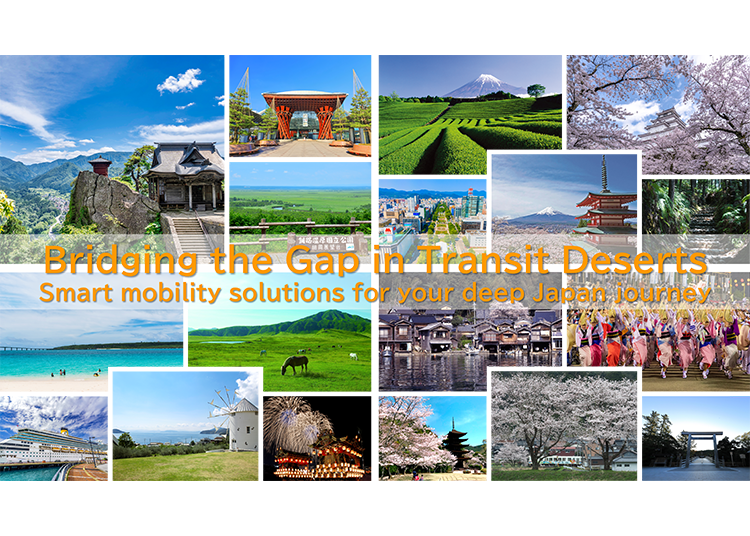
The Latest Guide to "Tourism Mobility": Traveling Japan More Freely. What exactly are Japan’s version of ride-sharing and transit deserts?
- Written by: LIVE JAPAN Editor
Every year, many international tourists visit Japan to enjoy its beautiful temples and shrines, magnificent nature, and delicious cuisine. However, on the way to these destinations, they sometimes encounter an unexpected barrier: the issue of transportation.
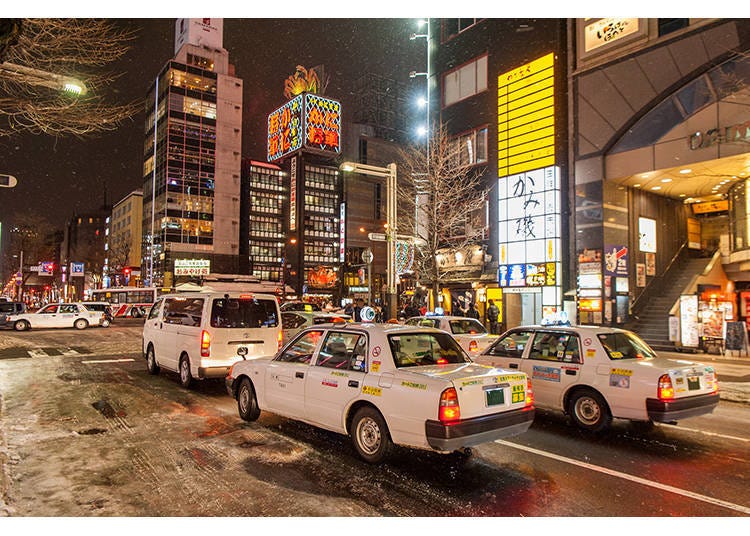
"I arrived at the station, but there are no taxis at all." "The buses are so infrequent that I have to wait two hours for the next one." "The last bus has already departed." If you have had such experiences in Japan, you may have encountered a "transit desert"—a challenge that the country is currently working to solve on a national level.
In this article, we will explain the challenges within Japan's transportation landscape and the new services created to address them. By understanding these options, you can ensure your journey through Japan is smoother and more comfortable.

What exactly is a "Transit Desert"?
The term "transit desert" is appearing more and more frequently in the news across Japan today. While Japan boasts a highly advanced railway network that seamlessly connects its major cities, the transportation landscape changes significantly when you venture into rural towns or mountainous tourist destinations prized for their natural beauty. In these areas, unlike in large metropolitan centers, factors such as population decline and a growing shortage of drivers can lead to a limited number of bus and taxi operations. This condition—where essential public transportation is not sufficiently supplied and mobility options are restricted—is what we call a "transit desert."

The Challenge of "Tourism Mobility"
Within the context of transit deserts, the issue that impacts international tourists most significantly is the shortage of what we call "tourism mobility." This term refers to the "last one mile" of transportation—the means of connecting major hubs like terminal stations and airports to specific sightseeing spots and hotels.
For instance, imagine arriving at a rural station by Shinkansen. When you attempt to reach a famous hot spring resort or a scenic viewpoint from there, you may find that the number of connecting buses or taxis is extremely limited. Cases where travelers cannot secure transportation are on the rise, particularly during peak seasons such as the cherry blossom or autumn foliage periods when visitors congregate, as well as during nighttime hours when guests return to their hotels after dinner.
To ensure that travelers who have come all the way to Japan can enjoy a stress-free experience, the Japanese government is currently launching a series of new projects aimed at bridging the gap in these "transit deserts."

Solution 1: "Japan’s Version of Ride-sharing"—A Unique Local Evolution
While ride-sharing services like Uber, Grab, and Bolt have become global standards, the model introduced in Japan is quite distinct. It is known as "Japan’s version of ride-sharing." You may wonder how it differs from the typical services found abroad. The most significant feature is that taxi companies manage the operations.
Rather than simply having an IT company act as an intermediary between drivers and passengers, Japan has implemented a system where professional taxi companies oversee the training of private drivers, verify vehicle maintenance, and manage overall operations. Consequently, these services are primarily deployed in regions and during time slots where taxis are in short supply.
Benefits for Travelers
You might ask, "If taxi companies are managing it, isn't it the same as a regular taxi?" However, this system offers substantial advantages for users.
A Seamless App-Based Experience
In many regions, the entire ride-hailing process is handled entirely via smartphone. You can often use the Uber app already on your phone, or access Japan’s leading domestic apps like GO and S.RIDE. By using these apps, you eliminate the need to explain your destination in Japanese or handle cash.
Currently, the service areas are expanding beyond major metropolises like Tokyo and Kyoto into rural tourist destinations, serving as a powerful lifeline when you cannot find a traditional taxi.
Regions where "Japan-style Ride-sharing" is available
Sapporo, Hokkaido
Available for travel within Sapporo City and its surrounding areas. The service is operational from 4:00 PM to 8:59 PM, Thursday through Sunday, and during the late-night hours of 1:00 AM to 4:59 AM on Saturdays and Sundays. You can access the service by downloading the "GO" or "DiDi" ride-hailing apps.
Toyako Town, Hokkaido
This service is available for transportation within the Lake Toya area and its surroundings. It operates daily until February 15, 2026, from 7:00 PM to 12:00 AM, and can be accessed through the "GO" app.
Niseko Region, Hokkaido
The service is available via the "GO" app until Sunday, March 15, 2026.
Echigo-Yuzawa, Niigata Prefecture
The service is available for use via the "GO" app.
Ise City, Mie Prefecture (Ise Grand Shrine & Ise-Shima)
Available for travel within Ise City and its surrounding areas until January 31, 2026. The service operates on Fridays and Saturdays from 8:00 PM to 12:00 AM and can be accessed via the "GO" app.
Kyoto City, Kyoto Prefecture
Available within Kyoto City via the "GO," "Uber," and "DiDi" apps during the following windows:
・Mon, Wed, and Thu: 4:00 PM to 8:00 PM
・Tue through Fri: 12:00 AM to 5:00 AM
・Fri through Sun: 4:00 PM to 6:00 AM (the following morning)
Okinawa Prefecture
Available on the main island of Okinawa via the "GO," "Uber," and "DiDi" apps during these times:
・Fri and Sat: 4:00 PM to 6:00 AM (the following morning)
・Mon through Sun: 1:00 PM to 7:00 PM
・Cruise Ship Port Calls: From the time of arrival until departure.
About "Public Ride-sharing"
In addition to the models managed by taxi companies, there is another option known as "Public Ride-sharing," which is spearheaded by local municipalities and NPOs. Its primary feature is that local residents—who possess deep, firsthand knowledge of the area’s roads—provide direct transport to your destination using their own private vehicles.
Although this system was originally established to support the daily lives of local residents, an increasing number of regions are now opening the service to international visitors to facilitate "tourism mobility." Beyond the sheer convenience of reaching hidden gems inaccessible by route buses without the stress of multiple transfers, the opportunity to receive "insider" information—tips and stories not found in any guidebook—directly from local drivers is a highlight of the experience.
If you are considering using this service, please first check the official website of your destination’s municipality or visit a local tourist information center to confirm its availability. By making smart use of this modern mobility option, you can enjoy a more flexible and profound travel experience in Japan to your heart’s content.
Regions where "Public Ride-sharing" is available
Noboribetsu, Hokkaido
Available for travel between JR Noboribetsu Station and Noboribetsu Onsen daily through February 20, 2026. The service departs from the designated boarding point in front of JR Noboribetsu Station at 8:00 PM and 9:00 PM. The fare is 2,000 JPY per person.
Context: Regular bus service to Noboribetsu Onsen ends in the 8:00 PM hour. This initiative was launched to provide "last-mile" night-time transportation for tourists arriving on later limited express trains. In the event that the ride-share is full or unavailable, taxis can be arranged via the "GO" app.
https://noboribetsu-ridesharing.com/en
Kaga City, Ishikawa Prefecture (Kaga Onsen Area)
Available via the "Uber" app at Kaga Onsen Station and the nearby Kaga Onsen villages (Katayamazu, Yamashiro, and Yamanaka Onsen).
・Sun – Thu: 7:00 AM to 11:00 PM
・Fri – Sat: 7:00 AM to 2:00 AM (the following morning)
Komatsu City, Ishikawa Prefecture (Komatsu Airport)
Service is available from Komatsu Airport and within Komatsu City to surrounding regions on Thursdays, Fridays, and Saturdays from 5:00 PM to 12:00 AM. Please check the official Komatsu City website for specific booking and arrangement details.
Fukuchiyama City, Kyoto Prefecture
A demand-responsive transport service operates from Oe Station throughout the Oe-cho area in Fukuchiyama City.
・Operating Hours: Saturdays, Sundays, and Holidays from 8:30 AM to 5:00 PM
・Booking: Advance reservation is required via the dedicated phone line by 5:00 PM, two days prior to your intended travel date. Please refer to the Fukuchiyama City website for more details.
Easier to Catch a Ride
On rainy days, Friday nights, or during peak tourist seasons when taxi fleets are stretched thin, additional vehicles driven by private citizens enter the service. This significantly increases your chances of successfully booking a ride through a dispatch app.
Solution 2: "On-demand Transportation"—The Best of Both Buses and Taxis
For those who wish to explore rural tourist destinations or "hidden gems" not found in guidebooks, "on-demand transportation" is an incredibly useful option. It is easiest to understand it as a hybrid between a bus and a taxi. Unlike conventional route buses that follow fixed schedules and paths, this is a flexible mode of transport that operates only when and where a reservation has been made.
How does it work?
While these services were originally designed for local residents, they have recently evolved into "AI On-demand Transportation" through the integration of AI technology. Consequently, the number of areas where tourists can easily book a ride via smartphone apps is increasing.
The defining feature of this service is ridesharing—sharing a vehicle with other passengers heading in the same direction. Thanks to this system, you can travel comfortably to your destination with a near "door-to-door" experience at a much lower cost than a taxi, even in areas without established bus routes. In regions where sightseeing spots are scattered across a vast area, on-demand transportation has become the primary means for getting around.
Regions where "On-demand Transportation" is available
Abashiri, Hokkaido
Pickup and drop-off services are available at various locations throughout Abashiri City, including hotels and tourist attractions, daily from 9:00 AM to 4:00 PM.
・How to Use:Plan: Review the operation map and decide on your departure and arrival bus stops.
・Book: Make a reservation via the dedicated phone line or the booking website.
・Wait: Once your reservation is confirmed, you will receive a notification with the estimated arrival time at your designated stop.
・Board: Please ensure you are at the bus stop by the scheduled time.
A convenient 1-Day Pass is also available. For more details, please visit the official website.
From Shin-Fuji Station (Shizuoka) to Lake Motosu (Yamanashi)
This shared taxi service connects Shin-Fuji Station (a Shinkansen stop) with Lake Motosu in Yamanashi Prefecture. It is an ideal option for travelers wishing to explore the western side of Mount Fuji, including famous spots like Shiraito Falls.
Service Details:
・Period: Operating daily through January 31, 2026.
・Frequency: 5 round trips per day at scheduled times.
Booking: No advance reservation required. Simply arrive at the designated time and location to board. For more information, please visit the official website.
Solution 3: "MaaS"—Integrating Every Part of Your Journey
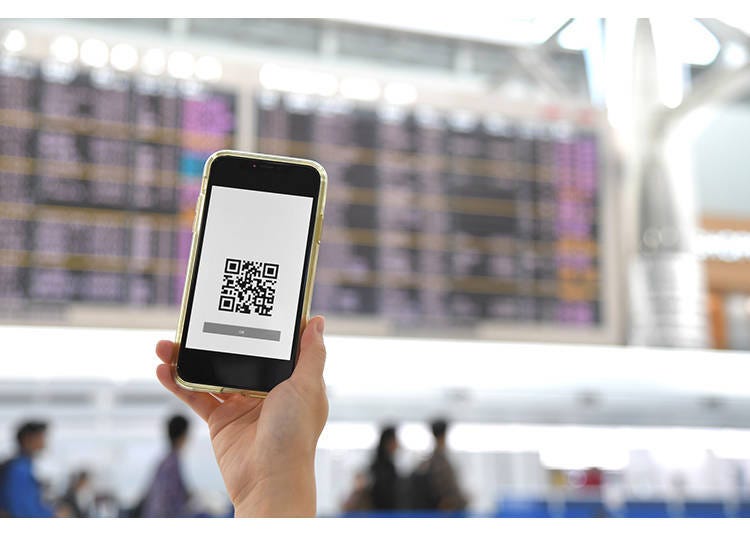
"MaaS (Mobility as a Service)" is a platform that integrates various modes of transport, such as trains, buses, and taxis, allowing travelers to navigate seamlessly without hesitation. In Japan, MaaS has evolved into something much more than a simple route-searching app. Its most distinctive feature is that it is often provided in a "Digital Ticket" format, which bundles not only transportation rights (for buses, trains, taxis, and bike-sharing) but also admission tickets to sightseeing spots and even meal vouchers.
The Value of MaaS for International Visitors
When navigating an unfamiliar land, the effort required to prepare small change for bus fares or to purchase new tickets every time the transit company changes can be a major source of stress. However, by utilizing MaaS apps or websites, you can free yourself from these hassles. Not only does this eliminate the need for tedious cash transactions, but it also allows you to manage the reservation and payment for all transport modes—including buses, taxis, and bike-sharing—entirely through your smartphone.
Furthermore, many services offer "all-you-can-ride" passes or excursion tickets that are more cost-effective than paying for each segment individually, providing both convenience and economic benefits. In Japan, many unique regional services exist, such as "Kansai MaaS." When planning your trip, we strongly recommend searching for your destination's name along with keywords like "MaaS" or "Digital Pass."
A More Comfortable Journey through Japan with Modern Mobility
While the term "transit desert" may seem negative at first glance, Japan is facing this challenge head-on by rapidly building new transportation systems that seamlessly blend technology with an unwavering commitment to safety.
Imagine how these solutions fit into your trip: in urban centers or at major stations where taxis are hard to find, "Japan’s version of ride-sharing" provides the perfect answer. When you venture toward beautiful rural villages or hidden gems, "on-demand transportation" becomes your reliable support for the "last one mile." The key to utilizing these options both smartly and economically is regional "MaaS" services.
Simply knowing these three keywords will dramatically expand the scope of your travels across Japan. Step beyond the standard spots found in guidebooks and discover the "unseen Japan" that awaits you. We invite you to master these new mobility options and enjoy a journey defined by freedom and comfort.
- Area
- Category
*Prices and options mentioned are subject to change.
*Unless stated otherwise, all prices include tax.
Popular Tours & Activities
-
Just 2 Hours from Tokyo! Escape to Yamanashi's NIPPONIA Kosuge, Where an Entire 700-Person Village Becomes Your Hotel
by: Alice Lee
-

The Best Sumo Experiences in Tokyo: Morning Practices vs. Sumo Shows
-

Haneda Airport Duty-Free Shopping Guide: What to Buy, How to Save & Where to Eat Before Your Flight
by: Guest Contributor
-
Ad

Pocket WiFi Rental in Japan 2026: Complete Price Comparison & Where to Get the Best Deal
-
Japan's New GREEN LIFESTYLE TRAIN Connects Tokyo, Yokohama, and a Greener Future
by: Guest Contributor
-

Top-Booked by International Visitors: Must-Try Italian & Pizza in Tokyo for First-Time Visitors
by: Guest Contributor
Inspiration for Accommodations
-

Family-Friendly Hotels with Free Shuttle to Disneyland: Convenient Access for a Magical Stay
-
Top Ranked Hakone Hotels with Mt. Fuji View: Enjoy Stunning Scenery from Your Private Space
-
Convenient Tokyo Hotels with Airport Shuttle: Ideal for Families and Heavy Luggage
-
9 Family-Friendly Hotels with Comfortable Family Rooms in Asakusa
-
10 Open-air bath Onsen Ryokans in Hakone for Ultimate Relaxation
-

Tokyo Sakura Tram: Experience Tokyo's Secret Neighborhoods, Off the Beaten Path!
-
Easy Day Trip from Tokyo! Ultimate Sightseeing Guide for Hakone & Lake Ashinoko!
-
Tokyo Train & Subway Guide: Navigate the City Like a Pro (JR, Subways, IC Cards & Passes)
-

Essential 25 Japanese Travel Phrases You Need to Know Before Your Trip
-
6 Fun Things to Do at Tokyo's World-Famous Tsukiji Outer Market!
-

Golden Gai – Tokyo Shinjuku’s Atmospheric Bar Wonderland and the Secrets Behind its Magic
- #best ramen tokyo
- #what to buy in ameyoko
- #what to bring to japan
- #new years in tokyo
- #best izakaya shinjuku
- #things to do tokyo
- #japanese nail trends
- #what to do in odaiba
- #onsen tattoo friendly tokyo
- #daiso
- #best sushi ginza
- #japanese convenience store snacks
- #best yakiniku shibuya
- #japanese fashion culture
- #best japanese soft drinks