




Japan’s crowded commuter trains are famous around the world, particularly during the busy morning and evening rush hours. To help millions of people travel smoothly each day, a unique set of unwritten train etiquette rules has developed over time.
While these customs may not be officially posted anywhere, many Japanese passengers are quick to notice when they are ignored. From blocking the doors to taking up too much space with luggage, certain behaviors can quietly frustrate fellow commuters.
To better understand these unspoken expectations, let's take a look at a survey ranking the train behaviors that Japanese people find most annoying. If you're planning to ride trains in Japan, these insights can help you travel more comfortably and avoid common etiquette mistakes.
Understanding Japan’s Train Etiquette with the “Most Annoying Behavior Ranking”

How do people in Japan feel about train etiquette? To find out, the Association of Japanese Private Railways, an organization representing 72 railway operators including Tokyo Metro, Tokyu Corporation, Keio Corporation, Seibu Railway, Odakyu Electric Railway, and Tobu Railway, conducts an annual survey on station and train manners.
The most recent survey was conducted online between October 1 and November 30, 2025, asking respondents which behaviors by other passengers they find most annoying while using trains and stations. Here are some of the survey's key findings.
Survey Details
・Survey period: October 1 – November 30, 2025
・Content: Etiquette in stations and trains
・Survey method: Web-based survey (multiple choice)
・Total responses: 5,202 people
*Each respondent was allowed to select up to 3 options.
- Coughing or sneezing without consideration for surroundings (34.7%)
- The way of sitting (not making room, stretching legs, etc.) (31.9%)
- Noisy conversation, rompish behavior (30.2%)
- Lingering near the doors (27.6%) [New Category]
- Using one’s smartphone (walking while using, using in a crowded car, etc.) (21.6%)
- Strong scents (perfumes, detergents, fabric softeners, cosmetics, etc.) (21.5%)
- The way of holding/carrying bags, umbrellas, etc. (20.1%)
- Etiquette when boarding/getting off (rushing onto the train, cutting in line, etc.) (20.0%)
- Leaving garbage, empty plastic bottles, etc. (12.9%)
- Riding the train while drunk (12.5%)
- Sound leaking from headphones/earphones (9.8%)
- Priority seating etiquette (8.9%)
- Doing one’s makeup in the train (7.9%)
- Eating and drinking in a crowded car (7.5%)
- Other (6.3%)
- How escalators and elevators are used (6.2%)
- Sounds/operation of electronic devices (laptops, handheld gaming devices, etc.) (3.4%)
- Nothing in particular (0.6%)
New Number 1: "Coughing or sneezing without consideration"

One of the most notable takeaways from the results is that "noisy conversation" is no longer the top annoyance. In recent years, "coughing or sneezing without consideration for others" has claimed the number one spot, reflecting a growing awareness of hygiene and public health.
Many passengers report feeling uncomfortable when someone nearby coughs or sneezes without covering their mouth or nose. The findings suggest that, for today's commuters, keeping the train clean and hygienic is just as important as keeping it quiet.
#2 “How to sit” – what are the most annoying aspects?

When respondents who chose "the way of sitting" were asked to pinpoint exactly what bothered them the most, spatial awareness (or the lack thereof) dominated the list. Here is the 2025 breakdown:
Spreading, stretching, or crossing legs (45.7%): This is by far the biggest offense. On a crowded Japanese train, stretching your legs out into the aisle or crossing them often trips people or rubs dirt onto standing passengers' clothes.
Not packing in tightly/leaving wide gaps or putting luggage on seats (31.9%): Train seats in Japan are typically long, continuous benches. Failing to slide over to maximize seating capacity—or worse, using a seat for a bag—is seen as highly selfish.
Body or luggage bumping into the person next to you (7.8%): Sitting with crossed arms that poke your neighbor, or holding a large bag on your lap that spills over into the next person's space, saw a notable increase in complaints from the previous year.
Children standing on seats with their shoes on (5.4%): While Japanese society is generally tolerant of children on transport, parents are expected to remove their child's shoes if they want to stand on the upholstered seats to look out the window.
Not yielding seats to those in need (5.3%): Failing to offer a seat to the elderly, people with disabilities, or pregnant passengers remains a consistent grievance.
The Root Issue: The "Invasion of Shared Space"
The overarching theme from the survey data is the strict policing of personal boundaries. Because there are no designated, separated buckets for every passenger on commuter trains, the seating is communal. When someone sits with their legs spread or leaves an awkward half-gap between themselves and the next person, they are effectively depriving someone else of a seat. In a culture that heavily prioritizes group harmony and "reading the room," acting upon one's own comfort at the expense of communal efficiency is viewed as a severe lack of social grace.
Doing one’s makeup in the train (#13): Japanese women do their makeup on the train?! That’s not annoying at first glance, but...

Among all the behaviors on the list, "doing one's makeup" in 13th place may come as a surprise. After all, it does not directly inconvenience other passengers in the same way as blocking doors or talking loudly.
However, many people in Japan view it as a matter of appropriateness rather than direct harm. Every public space has its own unspoken expectations. For example, eating and drinking are perfectly normal in a restaurant, but the same behavior may feel out of place in a setting designed for a different purpose.
From this perspective, trains are seen primarily as shared spaces for transportation. While applying makeup affects only the person doing it, many passengers feel that personal grooming is something better suited to a private space. As a result, the act can make others uncomfortable and is often regarded as poor train etiquette, even if it does not directly interfere with anyone else's journey
Eating and drinking in a crowded car (#14): That’s a taboo as well?

Eating and drinking on trains are often viewed differently because they can directly affect the people around you. Beyond the smell of food and beverages, eating naturally creates chewing, sipping, and other sounds that can be noticeable in a quiet carriage.
In Japan, where many commuters value a calm and unobtrusive environment, these sensory impacts can be a source of irritation. Food and drinks may draw attention visually, generate noise, and produce lingering odors, all within the confined space of a train. For this reason, even though eating and drinking are personal activities, many passengers feel they have a greater effect on those nearby than other individual behaviors.
Specific Nuisances: Did You Do Something Unknowingly?

Let's take a closer look at three common categories of train etiquette that often frustrate passengers: "how people sit" (#2), "how bags and luggage are carried or stored" (#7), and "boarding and disembarking manners" (#8).
While these may seem like small details, they can make a big difference on Japan's often crowded trains. Keeping a few simple etiquette rules in mind can help make the journey more comfortable for everyone and ensure you don't unintentionally inconvenience those around you.
#2 “How to sit” – what are the most annoying aspects?

Pay attention to personal space when sitting! Try to touch your neighbors or people standing in front of you as little as possible.

Among the complaints related to "the way people sit," two of the most common are taking up more than one seat and stretching or crossing one's legs in a way that encroaches on others' space.
On crowded trains, passengers are expected to be mindful of the limited room available and to make space for as many people as possible. Actions that reduce available seating or make it difficult for others to sit comfortably are often viewed as inconsiderate. Even when trains are not completely full, many people prefer to maintain a reasonable amount of personal space, making these behaviors a frequent source of frustration.
#7 ”The way of holding/carrying bags, luggage, etc.” – what are the most annoying aspects?

・Carrying a backpack or bag on one’s back (27.7%)
・Mishandling umbrellas (wet umbrellas brushing against people, pointing the tip at others) (18.2%)
・Holding a bag in front of one's body (17.6%)
・Carry-on suitcases (10.4%)
・Luggage placed on the seat (9.2%)
・Luggage placed on the floor/at one's feet (6.8%)
Wearing a backpack on a crowded train is a nuisance! Let’s take it off before getting on

Among the complaints related to bags and luggage, one of the most frequently cited issues is carrying a backpack or shoulder bag on your back. On crowded trains, it can be difficult to tell when your bag is bumping into or taking up space around other passengers, especially during rush hour when people are packed closely together.
As a result, a widely accepted train etiquette rule in Japan is to remove backpacks and carry them in front of your body. While this custom may not be obvious to visitors who are unfamiliar with Japan's crowded commuter trains, it is considered an important courtesy.
Passengers also expressed frustration with luggage placed on seats or left on the floor where it can obstruct others. As a general rule, keep your belongings close to your body, avoid taking up extra space, and hold bags in front of you whenever possible.
#5 ”Not following etiquette when getting off/letting people get off” – what are the most annoying aspects?

・Lingering near the doors (blocking boarding/disembarking, not moving further in) (26.6%)
・Boarding before letting people off (22.9%)
・Cutting into the boarding line (18.9%)
・Rushing onto the train (18.2%)
・Shoving people around (8.3%)

Another major source of frustration is boarding and disembarking etiquette. One of the most fundamental unwritten rules of train travel in Japan is simple: let passengers exit before boarding.
To make this process smoother, several customs have developed over time. Passengers standing near the doors will often step off briefly to allow others to exit, people already inside the carriage move farther in to create space, and those waiting to board typically line up in two orderly rows on either side of the doors.
Not surprisingly, many of the top complaints in this category involve people ignoring these conventions. The biggest annoyances include lingering in front of the doors and blocking the flow of passengers, boarding before others have had a chance to get off, and cutting ahead of people already waiting in line.
These customs reflect a broader emphasis on consideration for others, something often associated with Japanese public etiquette. However, with trains packed full of commuters rushing to work or school, not everyone follows these unwritten rules. When that happens, it can quickly become a source of irritation for fellow passengers trying to navigate an already crowded environment.
What is Common Courtesy Inside the Train?

Part of the “nuisance ranking” was not only larger and smaller grievances but also positive acts and customs that make the shared train experience easier to bear. Here are some examples.
・ I gave my seat to a senior and not only did they thank me as they sat down, they thanked me again as they got off. (50s, female)
・ When I was pregnant, I was standing close to the doors, but someone saw the pregnancy tag on my bag and very kindly offered me their seat. (30s, female)
・ When someone with a stroller tried to get off the train, the people around them actively helped them with it, that warmed my heart. (20s, male)
・ I saw a student help out an international tourist by showing them the route on their smartphone, and I thought that was great. (40s, female)
・ I wanted to move further back in a crowded car and said “Excuse me.” The person in front of me took down their backpack to let me pass. (30s, female)
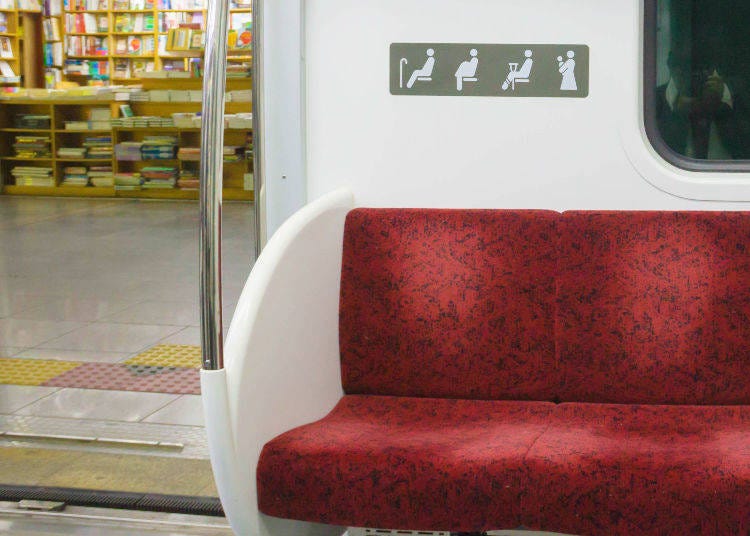
Of course, train etiquette is not only about avoiding behaviors that annoy others. Positive actions, such as offering a seat to an elderly passenger, someone who is pregnant, or a person who may need assistance, are also highly valued. Even a simple word of thanks for a considerate gesture is seen as an important part of everyday courtesy.
At the same time, many people in Japan feel that public interactions have become more reserved in recent years. Although commuters are often busy and focused on reaching work or school, there is also a broader tendency to avoid unnecessary involvement with strangers.
Modern Japanese society brings together people from a wide range of backgrounds, lifestyles, and perspectives, particularly in densely populated urban areas. As a result, many people adopt a cautious approach to public interactions, preferring not to intrude on others or draw attention to themselves. Respecting personal boundaries and avoiding unwanted interference have become important social norms.
This may sometimes make people appear distant, but it is often rooted in a desire to be considerate and avoid causing discomfort. Understanding this balance between courtesy, personal space, and mutual respect can help visitors better understand the etiquette that shapes daily life on Japan's trains.
A New Focus: Nuisances by Inbound Tourists
With the rapid increase in foreign travelers utilizing Japan's railway networks, the 2025 survey introduced a special category regarding inbound tourists. An overwhelming 77.1% of respondents reported experiencing nuisance behavior from tourists.
The top three complaints were:
#1. Noisy conversation and rompish behavior (69.1%)
#2. The way of holding/carrying bags and umbrellas (41.9%)
#3. The way of sitting (26.2%)
These behaviors are highly tied to travelers who may simply be unfamiliar with Japan's "etiquette of silence" and spatial awareness in shared public transport.
Final Thoughts

Etiquette varies from country to country, but its purpose is largely the same everywhere: to help people share public spaces comfortably and respectfully. When visiting another country, understanding and adapting to local customs can go a long way toward creating a smoother experience for both visitors and residents.
Japan's train etiquette has developed over decades through the daily experiences of millions of commuters. These unwritten rules are not just for Japanese passengers; they help keep one of the world's busiest rail networks running efficiently and comfortably for everyone.
When riding trains in Japan, paying attention to your surroundings and being mindful of local norms can make your journey more pleasant and help you avoid unintentionally inconveniencing others. A little awareness and consideration can go a long way toward ensuring a comfortable ride for everyone on board.
- Area
- Category
*Prices and options mentioned are subject to change.
*Unless stated otherwise, all prices include tax.
Popular Tours & Activities
Recommended places for you
-

Daikoku PA Car Meet: What Is JDM, and Why Do Enthusiasts Flock Here?
-
Autumn in Japan 2026: Fall Foliage Forecast & Where to Enjoy the Colorful Leaves (+Tour Info)
-
Haneda Airport Duty-Free Shopping Guide: What to Buy, How to Save & Where to Eat Before Your Flight
by: Guest Contributor
-
Japan's New GREEN LIFESTYLE TRAIN Connects Tokyo, Yokohama, and a Greener Future
by: Guest Contributor
-
Ad
Pocket WiFi Rental in Japan 2026: Complete Price Comparison & Where to Get the Best Deal
-
7-Day Japan Weather Forecast: Tokyo, Osaka, Sapporo, Sendai, Fukuoka, Naha – Plan & Pack Smart for Your Trip
Inspiration for Accommodations
-

Family-Friendly Hotels with Free Shuttle to Disneyland: Convenient Access for a Magical Stay
-
Top Ranked Hakone Hotels with Mt. Fuji View: Enjoy Stunning Scenery from Your Private Space
-
Convenient Tokyo Hotels with Airport Shuttle: Ideal for Families and Heavy Luggage
-
9 Family-Friendly Hotels with Comfortable Family Rooms in Asakusa
-
10 Open-air bath Onsen Ryokans in Hakone for Ultimate Relaxation
-
So You Think Your Commute Is Tough? Check Out Japan's Top 10 Most Crowded Commuter Trains!
-
'Thought I'd Die in Japan' - 8 Cases of Reverse Culture Shock Discussed by Foreigners Living in Japan
-
Exploring Tokyo: 4 Must-Visit Spots around Tokyo Station
-
(Video) Walking Tour along Narita Omotesando - Quaint Historical Village near Narita Airport!
by: Victor Gonzalez
-

'In the elevator...' Reasons why a British person was shocked when they visited Japan
-
6 Fun Things to Do at Tokyo's World-Famous Tsukiji Outer Market!
- #best ramen tokyo
- #what to buy in ameyoko
- #what to bring to japan
- #new years in tokyo
- #best izakaya shinjuku
- #things to do tokyo
- #japanese nail trends
- #what to do in odaiba
- #onsen tattoo friendly tokyo
- #daiso
- #best sushi ginza
- #japanese convenience store snacks
- #best yakiniku shibuya
- #japanese fashion culture
- #best japanese soft drinks