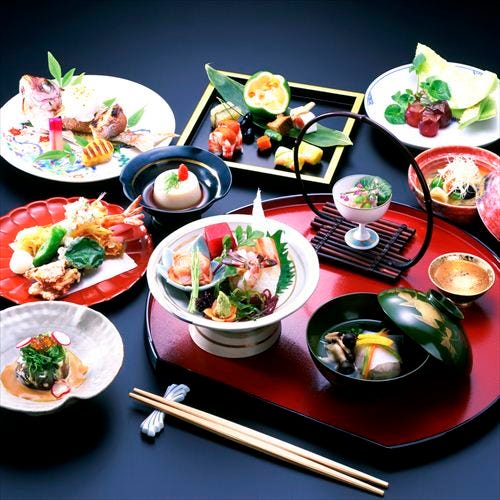
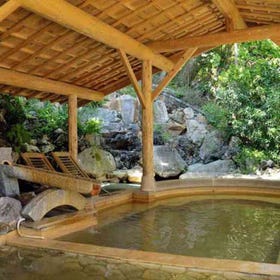
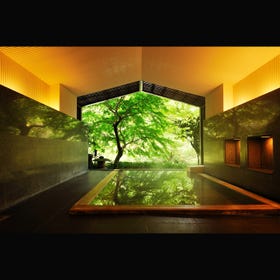
Genuine log house accommodations in about 2.8 acres large premises. At the restaurant, you can taste homemade Japanese course meal cooked with ingredients in season. In the 5 open air baths, you can enjoy bathing in nature. They are also available to charter.
Seasonal blossoms can be enjoyed along the paths running past the park’s streams and ponds, providing a chance to take a relaxed stroll while savoring the season. We also offer casual nature experiences, such as observing the ecosystems living in streams, viewing seasonal plants and flowers, and bird-watching. There is also an obstacle course located near the park entrance and we are the starting point for various hiking trails. From early February to mid-March, the entire mountain side erupts in plum blossom, filling the park with its sweet fragrance. BBQ can be enjoyed from April to October. Access: From Yugawara Station, take the bus headed to Makuyama Koen for about 20 minutes We are located right next to the Makuyama Koen bus stop
An inn attractive with its quiet location which is 5 minutes walk away from Gora station. They own a spacious premises of 7700 square meters. You can enjoy the Ide-yu hot water of Gora at a reasonable price. Dinner is Kansai style kaiseki (traditional course) meal.
A large hotel with complete hot spring facilities. There is the main building which serves meals in-room, and the annex which serves meals in the restaurant. There are Japanese style and Japanese-Western style guest rooms.
It is 10 minutes' walk from the plum grove with 3000 red and white plum trees. The rooms are chic, with wood flooring and blue-grey walls. The windows have a good view, with a sense of openness. The open-air bath, which can be reserved for private use, is highly recommended.
The hotel pays detailed attention to what female guests would like, such as the interior decor and furnishings in the building. Guests may experience an atmosphere of four seasons in an open-air bath with the concept of a Japanese-style garden, and the bath has an effect to make your skin beautiful.
[Takes around three hours 25 minutes at a regular pace - suitable for regular walkers] From the peak of Mt. Nango, 610 meters above sea level, you can enjoy incredible views of the Manazuru Peninsula stretching out into Sagami Bay. People who are interested in old legends can head to Jigansui pond. It is where Minamoto no Yoritomo is said to have gone to commit suicide after losing the Battle of Ishibashiyama. Legend says, after seeing the miserable image of himself reflected on the water, he returned to the fight. Nearby you can also see the remains of Komichi Jizodo (hall for guardian deities), which appears in “Genpei Seisuiki” (The Rise and Fall of the Minamoto and the Taira Clans), and is a good place to stroll while thinking about the Sengoku period. Access: From Yugawara Station, take the bus headed to Kajiya for about 15 minutes The start is right next to the Kajiya bus stop
A new style hotel opens its large open-air bath on the roof also for day visitors. There is a famous Tamadare-no-taki (waterfall) in the garden. Its water called Enmei-no-mizu which is considered to be good for a long life. It's a popular spiritual spot.
The Yugawara bathing beach is shallow and very popular with children. Size: 500m x 150m Family huts: about 20 Entry fee: Adults - 1,000 JPY, children - 600 JPY *Does not include parking fees Access: From Yugawara Station, take the bus headed to Manazuru Station for about 5 minutes We are next to the Yoshihama Koban-Mae bus stop
This shrine has a long history, going back to the time when Yugawara was developed by Shigeyuki Kaganosuke Futami and others. It is said that when Yoritomo Minamoto raised an army in Izu, Sanehira Jiro Doi, the head of the powerful local clan, prayed for his master Yoritomo's victory and offered the sword he carried at his waist to the shrine. The Myojin-no-kusunoki camphor tree spreads its branches by the side of the prefectural road. This tree is estimated to be over 800 years old and has a root circumference of 15.6 meters. An inner section of the trunk has decayed and been reinforced with concrete, which has been used to house a guardian deity. Access: From Yugawara Station, take the bus headed to Okuyugawara or Fudo-Taki for about 5 minutes The shrine is next to the Gosho Jinja bus stop
A long-established hotel located at the entrance of Manyo Park, in the center of the hot spring district. The traditional tea-ceremony arbor wooden building has large baths with a rich amount of water pouring from its own original hot spring source. Open-air baths with a jet bath and a private bath are available.
The hot spring source is a natural flow of slightly reddish cloudy hot water. 100% pure hot spring water from the source is luxuriously used for the indoor bath and open-air bath. The water is potable and is effective against gastrointestinal diseases. Located in an open area, the view from the rooms is fantastic.
The artist Kyotaro Nishimura visited Yugawara to rest and recuperate, and he was so enchanted by its climate and people that he decided to live here. The Nishimura Kyotaro Museum was opened in honor of him. In addition to more than 300 of his creations, we also exhibit items that represent his life as a writer, including handwritten manuscripts, large dioramas and his secret collection. Please stop by and get a new insight into the life and work of Kyotaro Nishimura. Access: From Yugawara Station, take the bus headed to Okuyugawara or Fudo-Taki for about 5 minutes We are three minutes' walk from the Shogakko-Mae bus stop
Despite its location at Yumoto Onsen, the entrance of Hakone, this hotel surrounded by trees is calm and quiet. The meals are kaiseki (Japanese course meal) cooked with seasonal ingredients from all over Japan. The view from the open-walled bath is like a painting.
A small inn located in Yoshihama, a little away from the Yugawara hot spring district. It is on a hill and you can have a relaxing bath while enjoying an ocean view. Enjoy thoroughly the dinner cooked with fresh seafood caught in the Sagami Bay.
A resort hotel in a rich natural environment with views of the Hakone mountains and the distant Mt. Fuji. The spacious large common bath and dining room with a superb view will make your stay very special.
There are 3 types of accommodations, the main building with a rooftop open-air hot spring bath with pebble floor, individually designed cottages and the Plaza with homey atmosphere. The rooftop open-air hot spring bath has a view of the streets of Yumoto.
A museum exhibiting works of art under the theme of pumpkins, with a focus on the work of world-famous artist Yayoi Kusama. The museum also has a cafe. [Yayoi Kusama] A painter, avant-garde sculptor and novelist born in Nagano. She began painting pictures based on hallucinations she had in her early childhood. She went to the USA in 1957 and stayed in New York for 18 years, and has also represented Japan at Venice Biennial in 1993. After her retrospective exhibition tour around the US, she held a large-scale, one-woman exhibition at the National Museum of Modern Art, Tokyo, in 1999. In 2001, she won the Asahi Prize. Her work has appeared at the Yokohama Triennale. Access: From Yugawara Station, take the bus headed to Okuyugawara or Fudo-Taki for about 5 minutes We are five minutes' walk from the Shogakko-Mae bus stop
A ryokan that takes only 5 groups a day. It is on a hilltop of Yugawara with beautiful views of the new green leaves in spring and autumn leaves in fall. Enjoy a relaxing bath in the hot spring, which is said to have water that makes skin whiter and more beautiful.
A French-style inn serving creative French cuisine located in the quiet forest of Sengokuhara Highlands. The highly experienced chef studied at a Michelin rated restaurant in Brittany, France.