




How is Kyoto City’s accommodation tax used? A complete guide to tax rates and how the funds are spent.
- Written by: LIVE JAPAN Editor
In many major cities around the world, accommodation taxes are standard practice. In Japan, these taxes are already collected in locations such as Tokyo, Osaka, Fukuoka, Kanazawa, and Hokkaido.
Kyoto City introduced its accommodation tax in 2018. The tax applies to all guests staying at lodging facilities within Kyoto City, including minpaku (private vacation rentals). It is collected by each accommodation provider alongside the room rate.
- Table of Contents
-
- Kyoto City’s accommodation tax
- What is Kyoto City’s accommodation tax used for?
- Example 1: Sightseeing Limited Express Bus service
- Example 2: Kyoto Tourist Information Center operation
- Example 3: Funding for traditional events such as Gion Matsuri and Gozan Okuribi
- Example 4: Preserving tradition and Kyo-machiya townhouses
- Example 5: Installation of movable platform gates at all stations on the Karasuma Subway Line
- Many other initiatives are being implemented
- The accommodation tax is not merely an expense
Kyoto City’s accommodation tax
Kyoto City’s accommodation tax rates are as follows:
| Accommodation Charge (per person per night) |
Tax Amount |
|---|---|
| Under 6,000 yen | 200 yen |
| Between 6,000 and 20,000 yen | 400 yen |
| Between 20,000 and 50,000 yen | 1,000 yen |
| Between 50,000 and 100,000 yen | 4,000 yen |
| 100,000 yen or more | 10,000 yen |
What is Kyoto City’s accommodation tax used for?
While Kyoto’s tourism industry thrives thanks to its many domestic and international visitors, it also faces overtourism. Roads are congested, and buses are crowded in certain areas during specific periods, while issues around littering and proper etiquette due to overcrowding have also become apparent. These issues affect residents’ lives and the scenery.
Kyoto is currently promoting sustainable urban development and striving to nurture harmony between residents and tourism.
Let’s look at some recent uses of the accommodation tax.
Example 1: Sightseeing Limited Express Bus service

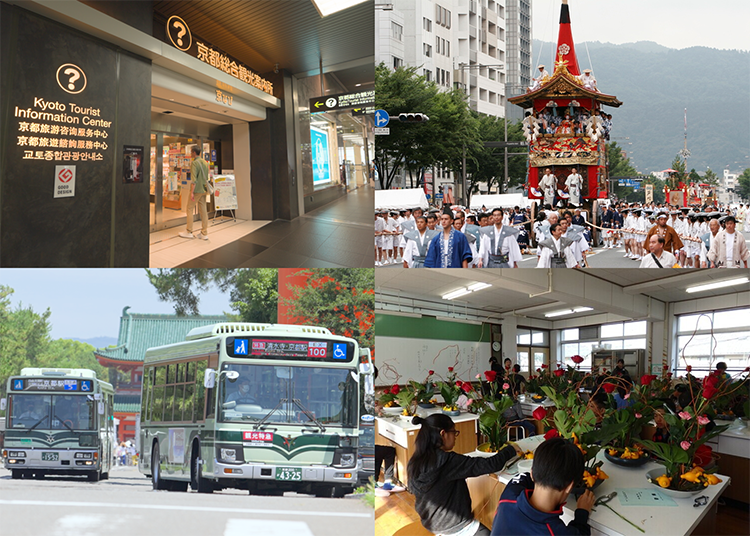
The Sightseeing Limited Express Bus, which was launched in 2024, stops only at major tourist destinations, making it ideal for tourists in a hurry. It operates on Saturdays, Sundays, holidays, the Obon and New Year’s vacations, and conveniently stops near Kiyomizu-dera Temple, Gion, Heian Jingu Shrine, and Ginkaku-ji Temple quickly. It is funded in part by the accommodation tax.
Example 2: Kyoto Tourist Information Center operation

At the Kyoto Tourist Information Center (“Kyo Navi”) located at Kyoto Station, multilingual professional concierges are on standby to help visitors with their travels. They offer advice on transportation and travel routes, ensuring enjoyable and smooth sightseeing in Kyoto.
Example 3: Funding for traditional events such as Gion Matsuri and Gozan Okuribi

Gion Matsuri is a traditional Kyoto festival with over 1,100 years of history, held every July and rooted in prayers to ward off disease. The elaborately decorated yamahoko floats parading through the city during the event are a spectacular sight. This festival was also designated as an Important Intangible Folk Cultural Property of Japan.

Gozan Okuribi is a ritual performed to send off the spirits of the deceased to the afterlife during the Obon festival. On the night of August 16th each year, giant characters and shapes are illuminated by flames on six mountains in the five districts surrounding Kyoto. This magical event is well known as a typical summer tradition in Kyoto.
Anyone can freely view the ritual, but it requires significant expense to ensure absolute safety. The accommodation tax is used so that the event can continue to be held and passed on to future generations.
Example 4: Preserving tradition and Kyo-machiya townhouses

As you walk through Kyoto’s streets, you will notice the unique Kyo-machiya townhouses, characterized by their beautiful lattice doors and charming tiled roofs. However, because maintaining these structures requires considerable effort and expense, their number is declining more and more each year. By preserving these townhouses, Kyoto can maintain the distinctive, beautiful streets and the charm of the ancient capital of Japan, as seen through a traveler’s lens. To pass on these townhouses to future generations, measures to support owners are being implemented.
Example 5: Installation of movable platform gates at all stations on the Karasuma Subway Line
The accommodation tax is being used to fund various safety measures, such as movable platform gates, which are progressively being installed at all stations on the Subway Karasuma Line. Their main purpose is to prevent passengers from falling and ensure safety. They also enable young children, the visually impaired, and all other passengers to use the stations with peace of mind.
Many other initiatives are being implemented

Other initiatives include:
● Operating the Kyoto Municipal Museum of Art, Japan’s oldest public art museum, which retains its original architecture while showcasing a wide range of artistic genres.
● Maintaining and restoring forests to protect and enhance the natural landscapes of the three mountain ranges surrounding the city: Higashiyama, Kitayama, and Nishiyama.
● Creating opportunities for children with great sensitivity to discover incredible culture and arts to foster the next generation of artists
There are many more initiatives not listed here.
Some initiatives can also be viewed in videos.
We had the opportunity to have a discussion with a staff member from the department handling Kyoto City’s accommodation tax. Here are a few words aimed at tourists visiting Kyoto:
“We are truly grateful to everyone visiting Kyoto from around the world. We responsibly use the accommodation tax collected in the city to maintain an environment where we can all enjoy a comfortable and safe stay. We hope all visitors will continue to enjoy the charming city of Kyoto.”
The accommodation tax is not merely an expense
More than an expense, the accommodation tax is carefully utilized as an investment in the future—preserving Kyoto’s beautiful landscapes and traditional culture, while ensuring a comfortable experience for all travelers. Visitors and local residents are all partners who share a love for Kyoto. This system serves as a bridge, connecting Kyoto’s timeless appeal to the next generation. We sincerely hope your stay in Kyoto becomes an unforgettable memory.
- Area
- Category
*Prices and options mentioned are subject to change.
*Unless stated otherwise, all prices include tax.

Popular Tours & Activities
-
Kansai Hidden Gem: Step Into a Real-Life Shangri-La at MIHO MUSEUM, I.M. Pei's Stunning Mountain Masterpiece
by: Wemmy Chau
-
Travel Hands-Free from Kansai Airport (KIX) with Yamato Transport’s New Counter
by: Guest Contributor
-
How to Ride Trains Like a Local in Kansai: Etiquette, Railway Culture & Historic Stops
by: Guest Contributor
-
10 Recommended Apartment Hotels in Kyoto for Long Stays and Family Trips
by: Yotsuka Hizuki
-
Ad
New Destination! UNIQLO's New Global Flagship Store Comes to Kyoto in November 2026
-
Top-Booked in Japan: Must-Try Sushi in Osaka for First-Time Visitors
by: Guest Contributor
Inspiration for Accommodations
-
Top Attractions in Osaka's Minami Area: Dotonbori, Sennichimae, Nipponbashi, Shinsaibashi & Horie
by: WESTPLAN
-
5 Popular Shops and Gift Ideas Along Arashiyama Shopping Street
-
10 Important Japanese Phrases to Know Before You Enter a Japanese Convenience Store
by: Teni Wada
-

Osaka-Kansai Expo 2025: 7 Must-See Exhibits at the Future of Life Pavilion
by: WESTPLAN
-
Complete Guide to Buying Japanese Medicine in Japan: Phrases and Vocabulary You Need to Know
-
KANSAI ONE PASS: Explore Osaka and the Whole Kansai Region with Just This Card and a Phone!
by: WESTPLAN
- #best gourmet Osaka
- #things to do Osaka
- #what to do in kyoto
- #what to bring to japan
- #best gourmet Kyoto
- #new years in Osaka
- #what to buy in nanba
- #Visiting Osaka
- #onsen tattoo friendly arima
- #daiso
- #Visiting Kyoto
- #best japanese soft drinks
- #japanese fashion culture
- #japanese convenience store snacks
- #japanese nail trends